Saturday, January 29, 2011

Three daughters re-united on Three Rivers

Hi, Vanessa here, the second of the Three Rivers. For the past few months the family has been scattered across the globe; with me studying in Brisbane, Australia, Hazel in the south of France, Victoria at Ottawa U and my parents in Turkey. It hasn't always been easy communicating in four different time zones, but somehow we managed to get ourselves organized for a long-awaited family reunion over the Christmas holidays aboard our new floating home, better known as Three Rivers.

Three sisters wearing matching shirts given to us by our parents

I must admit, the thought of cramming all five of us together in fairly confined conditions for several weeks had me a bit...worried. Although it has been five years since we've all lived under the same roof, it was a quick adjustment for our family to become accustomed to life on the boat.

So what it is like living with three sisters and their parents on a 43 foot sailboat? It means that when one person gets up in the morning, everyone gets up. I used to wake up to the sounds of my father making coffee and feeding our cat in the morning. Now I wake up to the sound of my father hosing down the boat, directly overhead of my cabin. It means that from 3pm to 4pm, we all have to be very, very quiet, because that is prime napping time for my father. At any given time, you know exactly where every member of your household is, and what they are doing. It also means that the only alone time you will get during the course of a day is when you visit the bathroom, and when you're asleep. And you know what?I'm having a great time.

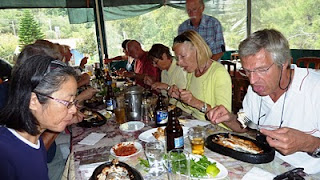
Ho family at Christmas dinner (we're not really this orange, my camera is just inferior)

Kemer has a lot to offer and I can see why my parents love it here. The Mediterranean coastline is breathtaking, especially against the backdrop of the recently snow-capped Taurus mountains. We’ve hiked some great trails leading to stunning vistas, visited historic sites dating from the Lycian era, and sampled some of the most exquisite oranges I’ve ever tasted.

Another beautiful day at the Kemer Marina

Intense outdoor ping-pong tournament

Freshly squeezed pomegranate juice at the market

Even though we probably won't have the opportunity to sail while we're here, we don't mind because there are plenty of new friends to make, tennis tournaments, bike trails to explore and even a ski trip in Antalya to keep us occupied for the remaining few weeks we have left. Looking forward to blogging about new adventures!

-Vanessa

Thursday, December 2, 2010

Wintering in Turkey

Kemer Cruisers Hiking Trip


View of the Lycian Way


Lunch at a trout farm restaurant


Top of the World! (at Termessos)


Beautiful Pine Forest


Halloween Party


Wintering in Turkey Dec. 2010

This is now early December. Back home in Canada, the temperature is around the freezing mark, and parts of Europe are getting covered in snow from an early winter storm. But in this part of southern Turkey, we are still enjoying day-time temperatures of 20-plus Celsius, mostly clear blue sky, and mild evenings. On this refreshing Sunday morning of Nov 28, we are among a group of Kemer live-aboard yachties on a hiking trip up to the Chimera, which is known for its eternal burning rocks. Legend has it that Chimera was the offspring of two underground ceatures called Typhon and Echidna, a strange beast that breathed flames from its month, with a front of a lion, rear of a snake and a middle section of a goat. It eventually was killed by Bellerophontes, who rode the flying horse Pegasus. However, Chimera was breathing fire even as it was taking its last breath.

In reality, the Lycian Way (Likya Yolu) is a 500-kilometer marked trail that meanders through ancient Lycia, Mediterranean Turkey's mountainous Tekke region. Parts of the trail goes through lush pine forests, crosses clear mountain springs, and ascends into high peaks that provide breath-taking vistas of the Mediterranean. Some of the trails can be reached from Kemer within 30 minutes of car ride. Most Sundays we have such hiking trips that take us through several hours of moderately strenuous hiking, and sometimes at the end of the hike we reward ourselves with a lunch at a one of the fish restaurants which are nestled in the mountain.

Hiking is just one of the many activities available to us live-aboards here at Kemer Marina. The active yachties here organize events such as Turkish lessons, tennis training and tournaments, workout sessions, dances, concerts, dinners, movie nights, special celebrations … we’ve been so busy that we are pressed for time on boat work. It feels like being on a holiday that doesn’t end. Such is the life of living-aboard at Kemer Marina, which is well-known among cruisers as one of the best marinas in the Med. Surrounded by tall mountains and shielded from the worst prevailing southern winter winds, Kemer has a micro-climate that is warmer and milder than most other parts of the Med. When we were planning our destinations this year, we had two choices: keep sailing and leave the Med and perhaps cross the Atlantic; or hang around here for winter, for another year of sailing in the Med next year. After a summer of fairly active sailing and having visited all the Eastern Med, we decided to take it easy for the winter and to experience the live-aboard life style at a nice marina. So far we have not been disappointed.

The majority of the yachties here are retired couples, from UK, Switzerland, Germany, Norway, France, U.S., plus the odd Canadians. They typically come to their boat during the moderate months – spring and fall, and avoid the hot months of July and August. During the cruising season they cruise the Med and stay at anchorages or marinas. Most have been living this lifestyles for many years, and they have not run out of places to visit yet. We have also come across some young ‘retirees’, successful professionals who sold their business and started cruising in their large modern yachts. There are also the long-distance cruisers who are sailing on smaller budgets, but enjoying it just the same. You go to the marina’s pub, the Navigator, at happy hours, and you get to meet all types. It’s fascinating.

The yachties also host special events at the Navigator. We celebrate birthdays, anniversaries, and special occasion such as Halloween and more recently, the US Thanksgiving party there. We, the line dancing group, "performed" a few dances at the party and here's the video: http://www.sonovela.net/video/IFqSKWpS_dE/Kemer-Marina-Thanksgiving-2010.html

Comes December 6, we will be celebrating the St. Nicholas Day with the Swiss, (interestingly, St. Nicholas was born in Patara, an important Lycian city along Turkey's Mediterranean coast), and there will be parade and treats. For sure, there will be cookies. For days, air in the marina has been filled with aroma of freshly baked goods ..... hmm, yum!!!

Friday, October 15, 2010

East Med Sailing

At anchor in Kekova


The colorful village of Kastellorizon


With friends from Red Shoes


The anchorage at Kastellorizon, on a calm day


Eliza trying to enjoy steering with a 25 knot following wind & sea


East Med Sailing

In mid-September sailing condition is wonderful around this part of the Med. The temperature drops to a comfortable 25C in the day, and is nice and cool at night. The Meltimi is still blowing and it extends further south-east to this side of the Mediterranean coast, and could provide for some exciting sailing. We headed north-west for another sailing trip for a couple of weeks, sailing by day and anchoring by night. This stretch of the Turkish coast is called the Lycian coast, and is known for its rugged mountains and majestic scenery. In ancient times this coast was feared by mariners as it’s exposed to the open sea with little protection, but now there are anchorages or marinas that are within a day’s sail. The first stop was one of our favorite cove, Cineviz Bay. Then we went to a small city, Finike, where we stayed at the marina for a few days for some sightseeing, and to get our batteries replaced. Compared to Kemer, Finike is a more traditional Turkish city, with little tourism, and has a rustic charm. The price of restaurants is also much better.

Then we continued onto Kekova Road, a stretch of protected water that is known as one of the best cruising grounds in Turkey. The four-mile-long island Kekova Adasi provides shelter to the prevailing winds, and there are numerous well-protected anchorages. We went into a little bay called Gokkaya Limani, and were attracted by its scenic bays and fjord-like channels. The water was wonderful to swim in. A freshwater spring bubbles into the sea, and it was refreshingly cool on the top layer. There were ruins all around, adding another dimension of interesting sights to this anchorage. The largest concentration of ruins is around the middle of Kekova, with a large castle atop a hill with commanding view of the channel. We stayed for two nights here, relaxing in the clear waters under the clear blue sky of the late-summer. Around us there were many yachts and gullets, including some true mega-yacht, but overall it was quiet and serene in the little bay. At night a full moon peeked into the opening of the bay, as if seeking entrance into the channel, and then rose up and cast a cool blue light onto the bay, silhouetting all the boats slowly swinging at anchor.

North-west of Kekova by another half-day’s sail is a charming small Greek island, Kastellorizon. At one point it used to be a bustling town of 20,000, but today there are less than 200 inhabitants. The island itself is a bare rock rising up from the sea, but the town and the colorfully painted houses dotting the island have a certain harmony and charm, and it’s great for walking around after having been on the boat for a few days. We pulled into a small bay called Mandraki and met up with our friends, a Canadian couple whom we met on the EMYR. We dropped anchor in front of a reef and took the dinghy to get into town. We had a light lunch in a little restaurant near the waterfront and then strolled through the narrow streets to look at the delightfully painted and well-maintained houses. It felt wonderful. We stayed at this anchorage for 2 days. On the second night, a strong wind sprang from the sea, blowing at over 25 knots and whipping the water in the small bay into white caps. Two neighboring boats dragged anchors and had to leave. We held an anchor watch until well after mid night when the wind finally died down.

The next morning we decided to raise anchor and to head back towards Kemer before the wind picks up. Pick up it did, and once beyond the lee of the islands, we were in the full force of over 20 knot wind and large seas. Fortunately the wind was behind us, so we ran with our small head sail in case the wind further strengthened. It was an exhilarating ride, but keeping the boat on a dead down-wind course with a choppy following sea took a bit of effort, so after a few hours we had enough and we hopped back into Kekova Road and took shelter in our familiar bay. Throughout the day more boats and gullets piled into the bay, seeking shelter from the near-gale warning issued by the Turkish weather office. Such was the moods of the sea.

Sunday, September 12, 2010

Gunkholing in the Med


Gunkholing in the Med

In early September the temperature was finally comfortable enough for us to venture out and did some gunkholing around this coast. This stretch of the Turkish coast is known as one of the best cruising grounds in the Med, with numerous coves and beaches that are very scenic and well sheltered. We started with those that are within a few days sail. Around this time of the year, wind is mostly from the north, and mostly on the nose for going up that way. We went to Cineviz Limani, a beautiful cove just a few hours from Kemer. The Turkish Pilot guide describes this cove: “The deserted bay is magnificent, with awe-inspiring cliffs dropping sheer into the sea….there is no other anchorage on this coast as grand as Cineviz”. We dropped anchor in 5 meters of water, took another stern line to shore to limit the swing, and stayed in this comfortable cove for a few days. At noon the gullets (large wooden charter boats) crowds into the bay with their hoards of tourists, but by evening the secluded bay only has a few cruisers and some small fishing boats. The water is clear and perfect for swimming, and the view wonderful. Fishing is apparently good too, but we have no fishing gears on board.

Another bay we visited was Tekirova. The bay is very picturesque, with a large sandy beach, pine forests, backed by a tall cliff and distant mountains. What makes this location unique is the historical ruins: The ancient Phaselis is just steps away off the beach. Dating back before Roman times, the ruins are fascinating and well preserved, including an ancient harbor, a paved boulevard, theater, Roman aqueduct, and sarcophagi lying around as they fell. We anchored here, and on daybreak we went on shore and walked around the ancient grounds in the morning twilight, sat on top of the theatre watching the morning sun gradually brighten up Mount Solymnus in the distance, probably exactly the way it was seen in 600BC.

Thursday, September 9, 2010

Cappadocia Tour


In September our daughter Hazel visited us, and we decided to do some land travel as well as some sailing. We joined a 3-day tour to visit Cappadocia, an area with fascinating rock formations and underground cave cities. Located in the eastern region of Anatolia, it is more than 12-hours drive away from Kemer, so most of the tour is spent on the bus, but the drive goes through the high Taurus Mountains and is very scenic. Having spent the last five months mostly at coastal areas, it’s also refreshing to be in the mountains and to drive through alpine forests.
We arrived the town of Gerome at about 6:00PM, and the arrival was timed such that we could see the sun setting over the high plateau where the ‘chimney rocks’ are located. The view was stunning. Formed from volcanic lava eroded over the millenniums, the forest of tall, cone-shaped rocks are in many interesting shapes. In the distance a high canyon glowed from the setting sun. In Gerome, some naturally-formed caves are carved and expanded into dwellings, including many cave hotels that are claimed to be 4-star hotels. Our tour package is only an economic package and our hotel was quite modest. But it’s clean and tidy, and the package included a traditional Turkey supper. The evening temperature drops to a very comfortable level, in contrast to the stifling heat in Kemer.
The next day we started early to get on a hot air balloon ride. The ride is quite expensive, but it’s another one of those ‘once in a life time’ events, and everyone who’s been to Cappadocia all highly recommended it. The idea is to see Cappadocia at dawn, from high up. It was a very interesting experience, to see the giant balloons inflated by huge propane torches, became bigger and bigger and gradually took off from the ground. And then in the open space just outside of Gerome, dozens of colorful balloons all took off one by one into the sky. The balloons were captained by certified balloon pilots, who skillfully drove the balloons at the right heights to get the best views for the scenery, riding the light winds and using burst of flame to control the height.
We then spent the day visiting different areas around Cappadocia and saw more interesting rock formation and rock caves, including some caves that were carved into churches dating back in Roman times.

Thursday, August 26, 2010

Life at Kemer


Life of a Live-on-Board Yachtie

We have been here at Kemer Marina for a month now. We decided to stay here a little while, explore the area, and enjoy life living on-board. Our original plan was to rest for a week or two here, and then keep sailing to explore other parts of Turkey, but the hot weather changed our plan. In August, the weather of much of Turkey is very hot, and often humid. Mid day temperature is typically 35C, with humidity it feels like 40C. It’s better at anchorages with a breeze, but it’s hot nevertheless. So rather than sailing off and getting broiled at anchorages, we decided to hang around the marina where we have shore power to run the air conditioner on the boat, and do some land traveling. Sailing will resume in September, when the temperature drops to a more pleasant level.

Kemer Marina is a first-class marina, with excellent facilities and within a short walk to town. The stony peaks of the Taurus Mountains provide a dramatic backdrop, framing the lush gardens and palm trees that dot the city. The marina is also part of a hotel complex, with a library, restaurants, swimming pool, and a tennis court. This entire area is a tourist playground, and an endless string of hotels line the beachfront, stretching for miles and miles. We are surprised at how well-developed the tourist industry is. Yes it’s a bit ‘touristy’, but we don’t mind, as we enjoy the vibrant atmosphere, with free evening concerts, beautiful beach-front settings, plenty of choices for restaurants, and Turkish coffee at side-walk cafés ….

Within a short drive, there are numerous attractions to keep one busy for the entire summer: numerous ancient ruins, beautiful beaches, diving, sea-turtle gazing, jeep safari, and rafting, just to name a few. We went rafting – under a blazing sun, the water was ice-cold and very refreshing.

We rented a car with some friends and explored the surrounding mountain regions. Compared to most other parts of the Med where the scenery is usually semi-desert, this region of Turkey is surprisingly lush, almost tropical. In less than half an hour drive down the highway from Kemer, there’s a good road that lead into the Taurus Mountains that rise to over 2,000 meters. A stream runs through the valley. The stream is just a trickle in the dry summer months, but there’s still enough water to keep some trout farms in operation and several restaurants, nestled in the valley by the stream, provide excellent seafood dishes. At the peak of the mountain, above the tree-line, one can see the Mediterranean Sea in the distance, framed by dramatic mountains peaks. The road peaks at a little village called Ovacik, and there’s a nice mountain hotel with a commanding view of the surrounding valleys and where one can take a rest for breakfast. And then going north-west, the road descents gently into a rolling forest of lush pine trees. The forest drops into a deep valley craved by an ancient river, and behind the valley, another mountain range rises sharply into the sky. In the winter, the peaks will be all snow-covered. The road eventually winds back to the sea, the perpetually blue Mediterranean sea.

Saturday, July 24, 2010

Passage from Israel to Turkey


Passage from Israel to Turkey July 20-23

We ended up staying for three weeks in the Herzliya marina in Israel, doing a fair amount of sight-seeing, boat work, and just plain relaxing. We are slowly getting to the life of a ‘yachty’ – people living on board. Most of our EMYR friends have now departed Israel, all 70 boats dispersed to the four winds. We met plenty of wonderful people, but this is a transient type of friendship. You may never meet one another again. So it is now time to get on the open sea again, and embark on the long 300 miles passage back to Turkey. Israel is nice, but Turkey is where the summer cruising ground is, and also there are more choices for marinas with vibrant cruising communities for staying the winter.

In July and August, the super-heated land masses of Turkey and Greece form a weather system that funnels strong winds that roar down the Aegean Sea, through the southern coasts, and empties into the Mediterranean Sea. This is the famed Meltemi winds, which blows North and Northwest at 20-30 knots. It slows down to 10-15 knots in the Southern Mediterranean, but nevertheless it means the passage will be mostly heading into wind, in seas that have been built up over a long fetch.

Once the coastline and high-rises of Israel receded from the horizon, there was nothing except the vast sea with endless shades of indigo blue dotted with white caps, under a friendly sky with a few patches of cotton clouds. Not a ship was in sight. We were truly alone now, unlike the EMYR where we were always sailing in a company of other boats and our position was always known and periodically updated with the team. We managed to sail about half the time, and motor sailed the rest. Wind was fairly steady at around 10-15 knots from NW, even through the night. This wind blows through two hundred miles of fetch, and at this side of the Med a considerable chop builds up. It was an uncomfortable ride, with the Nauticat ploughing through two-meter swells plus some steep waves. After the three-week rest in Israel, it took us a while to get our sea legs back.

We had intended to sail as much as possible on this passage, and only turn on the engine when the wind is absolutely too little. We did manage to sail a fair bit, but it worked out that we still had to motor-sail often. The basic reason is that we still had a schedule to meet: We need to arrive by Friday when the Turkey check-in offices are open, otherwise we would need to anchor somewhere during the weekend. Also if we had relied on sail only and tacked about, it would prolong the sailing time significantly, and open up the weather window to potential adverse weather. This is late July, after all, with a good possibility of heavy weather. Such are the restrictions of a longer voyage. So we ran the iron horse when needed and motor-sailed half the time.

By the third night, with the Turkish coast only 50 miles away, the wind direction shifted to westerly, on the beam. The sea was also much calmer. It was a nice smooth sail, a full moon shined through a cloudless sky and lit up the sea behind us. It was a nice way to end a 1,400 mile sailing journey.