Tuesday, July 26, 2011

Eastern Sardinia July 16 - 20

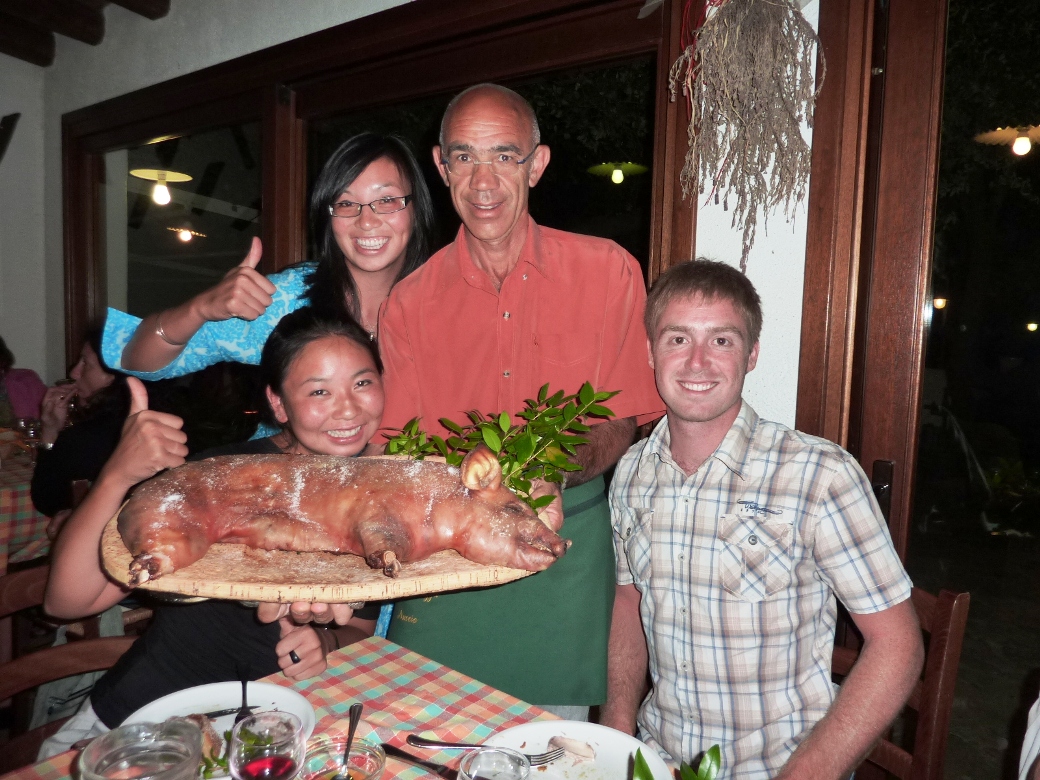
Roast suckling pig!


Ocean vista at a mountain pass


Eastern Sardinia July 16 - 20

After a peaceful night at Porto della Tavarna, we’re fully rested and ready to motor into the narrow channel of Golfo di Olbia. Once passed the N cardinal buoy and the lighthouse at the entrance, we just followed the marked beacons. On either side of the channel, there are mussel farms, with hundreds of buoys set on the water.

Olbia is a commercial town with airports, one for well-to-dos to land their private jets to get to Costa Smeralda and the commercial one for mainland connection. Unlike most of Sardinia, Olbia is well-protected from any strong winds. Some yachts are able to moor alongside the old commercial quay with no worry of any major blows, but there have been reports of break-ins and theft. We berthed at Circolo Nautico Olbia, a small, friendly club marina close to the town. The place was run by Salvatori and there’s a St. Bernard ‘guard’ dog named Penelope and she got the look of a lion!

Santa Maria Navarrese is a small, nice resort town. Some people would base here and explore the surrounding Gennargentu National Park, however, it’s just enjoyable to take a short hike up the bellavista and here, one could have the wonderful view over Isola dell’Oligastra towards Arbatax.

Sardinia interior has one of the most splendorous rugged Supramonte. It has mountains/seacliffs/gorges/canyons packed in one island, and the area of Ogliastra is considered as climber’s paradise, one of Europe’s finest.

We ended the day by driving into Tortoli/Arbatax, a town we knew reasonably well, with its well known Rocce Rosse, and Porto Frailis. At 6:00pm, we bided farewell to Jade, who soon would continue on her journey to Morocco.

Golf of Orosei, Sardinia July 9 to 1


Golf of Orosei, Sardinia July 9 to 16

Sardinia is the second largest island in the Mediterranean, and is mostly known for its impressive coastline. We set our course from Filicudi to Arbatax, in the hope that we could enjoy sailing the imperious coastline of the Golfo di Orosei with Don and Nancy before their departure at Olbia on July 13. Miraculously, wind speed and direction were on our side and we arrived at the Arbatax Marina exactly on schedule.

The town of Arbatax is known for the rocce rosse (red rocks), a series of weather-beaten rocks rising from the sea, with a white sandy beach nearby. There’s no shortage of accommodation along the streets leading to the beach, and surprisingly, they’re all very well-kept and some private homes even have the “Architectural Digest“ style. We were further surprised by the meal we had at the Ristorante Arbatasar, which was beautifully set inside the Arbatasar Hotel. We had a “Michelin”grade meal, and with staff attended to all details, it was one of the most memorable dinners we’d had.


                                         The fantastic coastline of Eastern Sardinia


                                         Tour boats in front of a sea cave


Friday, July 15, 2011

Passage to Sardinia July 7-9

Passage to Sardinia      July 7-9

From Filicudi island we started our 250 NM westward passage to Sardinia. Aiming for a somewhat unusual window of moderate south-east winds, we were hoping for a passage of mostly by sail power. The forecast turned out to be right on. Except for the first day of going through the Sardinia north coast, which typically has very little wind, we had good wind on our beam. Sailing with just the genoa and mizzen and moving at a steady 5 knots, we timed the passage for an early morning arrival at Arbatax, Sardinia. On the first night we had light wind and we motored. The night sky was brightly lit, first by a crescent moon and then by the immense cast of stars. It was a treat lying on the foredeck, watching the Milky Way stretching through the sky, and the occasional comets shooting by. On this Thursday night there was a fair amount of ship traffic, keeping us busy checking with the AIS. The next day, wind was steady at 10 knots, and towards the evening the waves began to build. The 2-3 meter waves, coming with the wind on the beam, created an uncomfortable rolling action. By night fall it was gusting at over 20 knots. With the jib furled a few rolls, the boat was cruising steadily at 5 knots, the gusts barely making an impact. And then, as if on cue, by early next morning the wind and the waves started to settle, perfect for our arrival at the Arbatax marina.

The happy crew

Aeolian Islands Juy 4-7

Aeolian Islands       Juy 4-7

An anchorage right in front of an active crater at Stromboli

The bay at San Vincenzo, Stromboli

Group picture by the northern side of Stromboli, where eruptions are most active


The Aeolian Islands are a group of seven volcanic islands that are part of a huge ridge that runs from Mounts Atna. They are noted for their spectacular volcanic formations, cobalt blue water, and, especially volcanic activities on two of the islands that are still active. Our plan was to sail through the islands with stops at two of the islands, Stromboli and Filicudi, and then head west to do our long passage to Sardinia. We visited Stromboli first. Minor eruptions still continue on a steady basis on this island, and as we approached the island we could hear low rumblings, followed by puffs of smoke. The island has the usual volcanic cone shape, but eruptions occur at not just the peak but at many craters around it. 

Milazzo July 3

Milazzo           July 3


We stopped at Milazzo to rest up and to get fuel and provisions before we head over to the Aeolean Islands, which are small volcanic islands with limited availability for provisions. We also needed to replace a broken alternator belt. Milazzo is a mid-sized city on the north coast of Sicily, next to a major refinery complex. The marina is a nice one, as reflected by the mooring fees (charge band 5!). The city is a pleasant surprise, with a nice waterfront and streets of tidy ancient buildings. In the evening, the waterfront was flooded with people enjoying the sea breeze, families with young children, fashionable young couples, along with the odd tourists. This region was once under the control of Spain, and parts of the city still have a Spanish feel. A large citadel rings the peak of a hill overlooking the harbour. Most of it is still in very good condition, particularly a church which has been beautifully restored and is open to the public as a museum.

Noto June 20

Noto

Noto is another UNESCO town near Siracusa. We took the AST bus and it went through Canicattini Bagni and Avola, during rush hour at 4pm, in order to be there later in the day to avoid the heat. Noto was designed in Baroque style, using the local white tufa, a limestone that has turned a honey-brown colour from sun, and it’s best seen at sunset when the light shines on the golden buildings.


Some of the best pastries we've had, ever!

A wedding party

Interesting facade of the Nicolaci Palace

One of the tasks Eliza enjoyed doing was in search for the “best” places to eat. In Noto, we enjoyed having dolce at CaffĂ© Sicilia and gelati at Bar-Gelateria Constanza. The pastry chef at CaffĂ© Sicilia had high regards from international critics and we’re delighted to have the opportunity to taste some of the finest cassata and slices of noccinata and mandoria. First bite and you could taste the pastry was made with fresh ingredients; the cream, nuts, and fruit favour just whelmed your senses. We ended our evening at Noto with the infamous gelato from Constanza. The place was packed. Again, some Italians really know a few things about how to put fresh cream, milk and fruit together in making a smooth, creamy, flavourful scoop of gelato.

Taormina Road June 29

 Beautiful beaches, viewed from the top of the road leading into Taormina

                                         Roman theater overlooking the city, Mt Atna in the back


Taormina Road              June 29

Finally it was time to say goodbye to Siracusa and head up the Messina Strait. We’ve stayed here at Siracusa and docked at the town quay for almost two weeks and have thoroughly enjoyed this lovely city.  On a bright Wednesday morning we lifted our stern anchor, which miraculously held our boat at the dock through 20+ knots wind. Heading north, the wind gradually picked up to over 10 knots and we were able to put up our sails and made good progress. Mount Etna was constant there on our port side, puffing a trail of smoke that casts a veil of haze over the entire area. The wind was tricky up the strait, gusting to over 15 knots, then dies down to nothing, then as soon as we started the engine, freshened again but from a different direction.