Friday, September 28, 2012

Sept. 24, 2012 Sardinia to Sicily: Another Rolly Passage


We have been working our way through southern Sardinia, having stopped at Cagliari for one night to get our smartphone connected, to get provisions and to have dinner at Su Cumbida for their well-known antipasti and suckling pig. Then we sailed to Villasimius, an anchorage at the south-east corner of Sardinia, where we waited for favorable wind to cross over to Sicily, a 165 miles journey to Trapani at the north-western tip of Sicily. The forecast called for 15-20 knots of wind from the south-west, which puts us on a very manageable broad-reach course. The seas were forecasted to be light at less than one meter.
The forecast turned out to be a bit wrong. Once we were out in the open sea, wind steadily increased to 20 knots with gusts of over 30 knots. The sea kept building and was soon at over two meters. It wasn’t dangerous, but the uncertain factor was: will it keep getting worse? After several hours, another boat that was sailing with us decided to turn around and head back to Sardinia. That was a tough decision in itself, as by then it was 15:00 in the afternoon, and turning back to Sardinia meant beating into strong headwind and seas, and arriving at the marina after dark. We decided to tough it out and kept going.

Large breaking waves 

Calmer seas at last, and greeted by friends!


Fortunately the wind leveled out and did not get much worse. However the seas kept building to over 3 meters, the roughest we’ve seen in the Med. The Nauticat handled this condition with no fuss, and despite the heavy seas and wind she held the course well. But occasionally a breaking wave hitting her at the stern pushes her slightly off and quick correction at the helm was needed to avoid broaching. The wind slacked off slightly at about sunset, as if to give us a break so we could have our supper. Soon after, it strengthened to 20+ knots again, howling through the riggings and white caps were breaking all around us. At about mid night we were at mid-way between Sardinia and Sicily, where ship traffic was busiest. We took 1.5 hour shift to manually steer the boat, and in between steering and dodging commercial ships, we had very little rest through the night.  With one particular cargo ship, we could see all the containers with little difficulty!  This 20-hour of excitement went on until 5:00AM, exactly as forecasted, we reached the quiet wind zone off Sicily.  The wind completely died, but the rolly sea continued on.  At daybreak we were greeted by three energetic young dolphins, which swam along the boat for several minutes before disappearing back into the waves. We motored for 6 hours for the rest of the way into the huge port of Trapani, with barely a whisper of wind.

Saturday, September 22, 2012

Sept. 17, 2012 From Menorca to Sardinia


Start of the passage to Sardinia - little wind, 2 meter swells

The gale at Mahon finally subsided. Forecast called for diminishing wind and seas the next day, and we timed our 200 nautical miles passage to Sardinia to make use of the still-fresh northerlies. On the day of our planned departure, it was still very windy during the morning and the afternoon, and from our boat we could still see large breaking waves crashing onto the shore in the distance. But by late afternoon the wind was beginning to settle, so we pulled our anchor and the long chain, all nicely buried in sand and mud, and waved goodbye to our friends who were still in the anchorage. We departed in the company of another boat which is also heading to Sardinia, Maximilian, a Moody 47. The white caps of wind-driven waves were gone, but the sea was still heavy with one to two meter swells. But the promised wind was nowhere to be found – in fact it kept dying! So we were left wallowing in the rolly sea, and after a while we had to turn on our engine to make headway through the night.

The next day we had light winds behind us, and we were finally able to sail, on a fairly smooth sea. It was a beautiful day, a cloudless sky reflecting off the endless expanse of deep blue sea. Our friends on the other boat saw a family of whales, but we had no such luck. Night came, a moonless night with a velvet sky completely filled with stars. The Milky Way was truly like a bridge of sparkling diamonds, stretching across the whole sky.
On the third day, after 40 hours sailing/motoring out from Mahon, we reached an island the south-western tip of Sardinia, and pulled into Marina Sifredi in the town of Carloforte. And the first comment we heard from a sailing yacht next to us was, you have a nice strong boat there. After going through rough seas and holding off some force 10 gales, we all came to appreciate having a nice strong boat!

The streets of Carloforte

Carloforte, the only town on the island of Isola di San Pietro, was founded in 1738 by a colony of Ligurian Fishermen from Tabarca (Tunisia).  The Ligurian origins of the country are still evident today in the traditions and architecture of the old town. From the marina, we were only steps away from the lively main square, Piazza Carlo Emanuele, where the streets are lined with palm tress. Narrow roads and alleys led to well-kept houses painted in pastel colors. Walking along the waterfront to the south, there’s a lagoon which is the occasional home for some pink flamingos, though we did not see any.


Having a delicious Sardinian meal with friends

We met up with some interesting cruising couples, and had a wonderful dinner at a restaurant serving local dishes of cheese and mushroom, antipasti of sword fish and tuna, followed by two versions of pasta with tuna (this is still a tuna-fishing town), grilled prawns and squids, fried sword fish, and finally finished with refreshing lime sherbet (spiked). Life is good!

Friday, September 14, 2012

Sept. 13, 2012 Gales of September


Storm clouds gathering, at the somewhat crowded bay 

Waves breaking at the outer shore, separated from our bay just by a narrow strip of land 

We are still anchored at the bay in Mahon, waiting for fair weather for the long passage to Sardinia. But fair weather seems hard to come by. September is the month of weather transition as the hot days of summer are replaced by cool days of autumn, and as if Nature is rehearsing the winter furies that will follow, there are frequent gales in this month. We were chased by one on the way to Menorca, and a week later there is another full gale blowing down the Gulf of Leon again. This is a gale with a serious attitude, a full force 10 at its centre, forecasted a week prior. The northern islands of Menorca, Corsica, and Sardina are most exposed to it’s path. So the yachties at this little bay are all staying put for the week, about a dozen yachts of different sizes and nationalities – Americans, Brits, Australians, French, Italians, and the lone Canadian. It makes a lively social scene, parties at each other’s boat while we wait for the storm to pass.

The storm lasted two days, started after mid night (so as to cause maximum coax!), reached force 7 with gusts at over 40 knots, settled down a bit the next day, and then resumed in full force the next evening at force 8, with gusts peaking at force 10. Our anchorage is a bay protected on all sides by low hills, so there are no sea waves but the hills are too low to offer any protection from the wind. One the north side, the bay is separated from the open sea just by a narrow strip of land, and from our boat we can see the large, white crested blue waves smashing onto the outer shore. Thankfully our anchor held, but not so for two other boats. They dragged anchor in the darkness of night, with the wind howling, waves being whipped into white caps even in the small bay. In 50 knots gusts it’s extremely difficult to retrieve one’s chain and anchor and then re-set the anchor, and they circled around the bay in repeated attempts to re-anchor. One boat hit several other boats, and another boat drift out of the bay and had to issue a May Day call for the coast guard to tow them back into safety. No one in the bay had much sleep that night!  

Sunday, September 9, 2012

Sept. 6, 2012 Mahon, Menorca


The 'hurricane hole' of Cala Taulera, a completely sheltered anchorage in Mahon 

Mahon harbor

After resting and recovering at a large scenic bay at the south coast of Menorca, we slowly sailed around the island to Mahon in a gentle following breeze. The storm of the previous days had passed, leaving a clear, blue sky with cool temperatures. It felt like early summer in Ontario, warm in the day but not hot, and cool evenings. It seems summer has come to an end right on schedule. Menorca lacks the dramatic high mountains of Mallorca, but it’s also a bit less ‘touristy’, and there are numerous bays around this island with beautiful beaches and perfect for anchoring.

We reached Mahon in the late afternoon. Once we rounded the south-east corner of the island and into the exposed north shore, the wind shifted from a light SW breeze to a strong north wind. The change was dramatic; one minute it was moderate wind gently pushing the boat along on a smooth sea, the next minute it was strong head wind, white caps washing onto the foredeck. Fortunately we were only a few miles from Mahon so we turned on the iron sail and turned into the completely sheltered anchorage at the outer harbor.
There’s an old saying that the only good times to sail in the Med is: July, August, and Mahon. Mahon is a huge natural harbor, several miles long, narrow in the entrance so it’s like a large lagoon. The marinas here are very expensive, and the only place where anchoring is allowed is at a bay called Cala Taulera near the entrance to the harbor. The cala is a very sheltered anchorage, but to get into town it requires either a 45 minute dinghy ride, or a long walk through a 6 km car road. We decided to try hitch-hiking, and was pleased to find that we had no problem getting a lift by nice tourists and locals. It feels like being young again, sticking our fingers out to hitch a ride.


The long walk from the anchorage to town.


The massive fortification of the La Mola guarding the harbor. It took 20 years to build, but has never been under attack


Horse rearing as part of the fiesta

We were in luck. During this last week of summer, there is a major festival (fiesta) taking place in town - Mare de Deu de Gracia, with horse riding shows, firework, and dance parties. Every day we hitched a ride into town to do some sightseeing, enjoying the ambience of this magnificent water front city, with its English architecture and Georgian townhouses dating back to the 18th century when Menorca was under British rule.
We took a 1 hour bus ride to visit another city, Ciutadella. The city was founded by the Carthaginians more than two thousand years ago, and in the 9th century under Arab rule was called Medina Minurqa. Thought to be the most beautiful of Menorca’s towns, with its 18th century aristocratic places, narrow arched passageways and courtyards, Ciutadella has a far more Spanish feel than the distinctly Anglo-Saxon Mahon. 


Ciutadella harbor and town


Sept. 4, 2012 A Rolly Passage to Menorca


Forecast called for 15 knots wind, the blue. Instead we got the green/yellow stuff!

We had planned to stay in Puerto Pollenca in Mallorca until the end of August and then sail to Menorca, another Balearic Island to the east. We’ve enjoyed the summer in Mallorca, taking many trips inland by bus or rental car, and have enjoyed visiting the many scenic, historical inland cities. The weather was hot in August – in fact the high temperature broke the 50-year record in Mallorca. But on the boat in the anchorage there was always a cooling breeze and rarely uncomfortably hot.
But at the end of August there was a major weather system across the whole Med., a Mistral that roars down from the Gulf of Leon and blankets the seas with gale force wind. It lasted for a whole week, and by the end of that we were feeling bottled up and were anxious to get moving. We had two choices – leave on this day with remnants of the sea and winds, or the next day which will have little wind. We picked the windier day, and on this Tuesday morning we waved goodbye to the many sailing friends we made here and departed for the 35 miles trip to Menorca.

Eliza enjoying the ride....most of the time

The marine weather between Menorca and Mallorca is notoriously unpredictable, as the strong north wind gets deflected by Menorca, and may leave the strait between the two islands relatively calm. But Menorca is a low-lying island with no tall mountains, so the deflection does not always work. As was the case on this day. The forecast called for a very manageable 15 knots, overcast sky. But once we left Mallorca, we were hit by a squall. Dark clouds filled the sky and cold rain poured down in large drops. Wind picked up to 30 knots, and waves quickly built to over 3 meters. We were caught with too much canvas. With a deeply reefed jib and full main, we were surfing down large waves on a board-reach at 8.5 knots – a record for us. But the Nauticat was in complete control, and rock-solid stable. Her directional control is excellent, despite the large quartering waves. Often when we were in marinas or anchorages, we watched those ‘Med boats’ with envy as they turn on a dime with nice maneuverability in tight quarters. But those light-displacement boats with narrow keels will not do too well in these conditions. I will never complain again about my heavy displacement boat with her long keel!

Nothing feels better than arriving at a beautiful, sheltered anchorage after a tough passage!

Saturday, August 18, 2012

Ibiza Town and beaches July 25, 2012


We took the bus from San Antonio to the city of Ibiza/Eivissa. It’s also known as the 'white island' due to the predominance of its white houses.  The Ibiza we know is the disco/club central, the summertime hedonistic capital of Europe.  La calle Barcelona is the central point of the city’s nightlife, based around the Port.  We did not go there. However, there are a number of interesting historical monuments which offer a bit of cultural, historical and natural richness within the city. We visited the 16th century walled city of Dalt Vila, a UNESCO World Heritage site.  The wall was built by Felipe II in the 16th century to protect the island from pirates and the OttomansPortal de Ses Taules, with a drawn bridge, is the main entrance to the Dalt Vila.  And once inside, we visited the Almudaina Castle, which was built during the Moorish period 12 & 13 centuries, and the Virgen de las Nieves Cathedral which was built upon an ancient Mosque in the 13th century in Gothic-Cataln style. Walked along the wall, we enjoyed the impressive view of the Port, the city below, and on a clear day, Formentera could be seen as well.  Although Archeological Museum was closed for renovation and the Episcopal Palace was now the Bishop’s resident and not open for public, we managed to visit the old Town Hall, which housed excellent pictures of the city’s past and present.  The Puig de Molins Monographic Museum, offered some of the best Punic art in Europe.  We were also thinking of venturing into the La Penya neighbourhood, located just below the Dalt Vila, but the staff in the tourist office was sternly against the idea as it was ‘not safe’. Instead, she offered a great number of great restaurants for us to try out.  We gladly took her advice and had an excellent lunch of traditional dishes of paella and fish at a small restaurant just outside the old city.

Entrance to the walled Old City

the Cathedral


  View from the Monographic Museum to the town harbor

Monday, July 23, 2012

July 20, 2012 Island of Ibiza


We waited for favorable east winds to sail the 50 miles from Mallorca to Ibiza. After a few hours of motoring, the wind picked up as predicted, directly astern at 15-20 knots. The waves began to build up quickly, but with wind and waves behind us, we were sailing comfortably under poled out jib and staysail. These days, with the luxury of simply waiting until the wind is right, we hardly need to run the engine anymore. It feels great!

 2 meter waves behind us...but the picture doesn't do it justice

Ibiza sunset, at San Antonio

Ibiza covers 575 Km2 and has a population of over 100,000. There is only one river, the Santa Eularia, on the whole island. The northern part of the island, known as Els Amunts, is made up of fertile land, small forests and almond and olive groves. The coast is spectacular with pretty coves and dramatic cliffs. The excellent sandy beaches are well equipped for tourists. The main touristic beaches are Portinatx, Port de Sant Miquel and Sant Vicenç
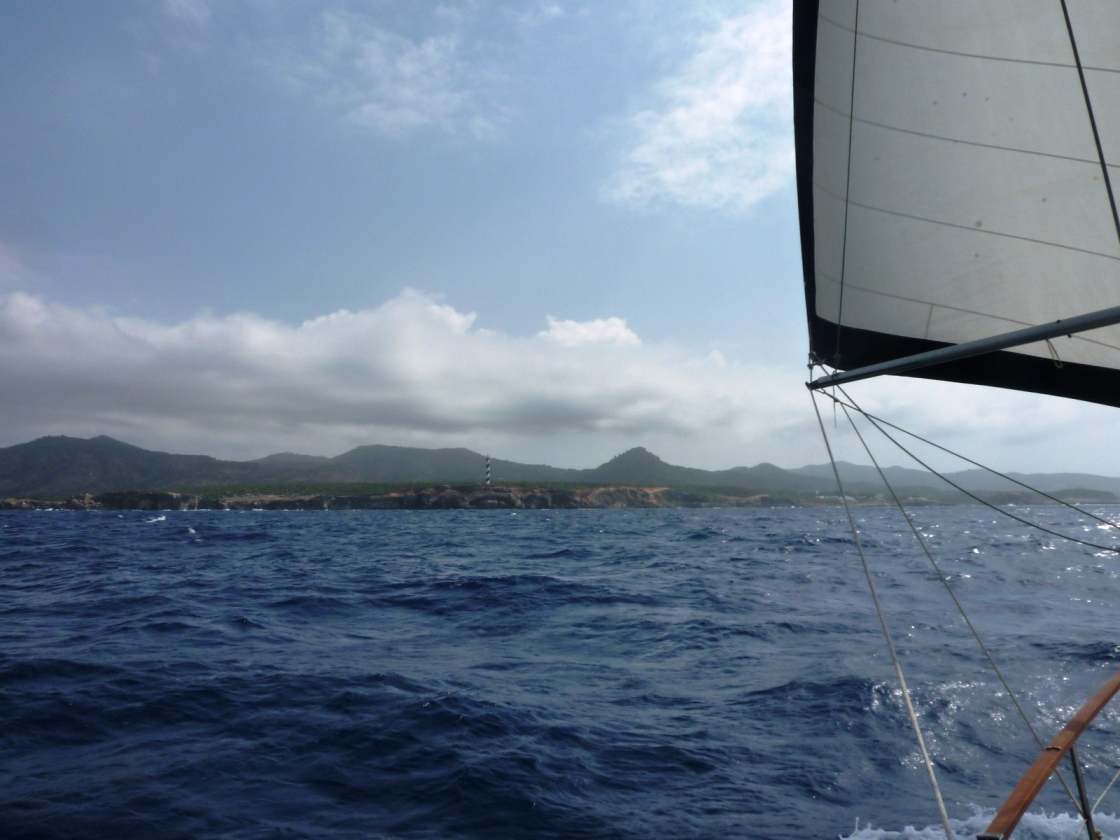
After nine hours, we saw land.  The trouble with sailing with winds behind us is that, by definition the approaching shore is a lee shore, and there were large breaking waves all over the shoreline. For better protection, we went into Cala Portinatx, against a backdrop of wooded mountains.  It was an attractive bay with three arms, each with a sandy beach, although crowded with sun bathers, pedalos and such. Since it’s a Saturday, it’s not unusual for the area hotel/restaurant to have some night music started at 9:30pm.  We did not think too much of it when the music went on into the night.  However, it went on till the wee hours of next morning …. 5AM should be considered morning …. it must be wonderful to be young and energetic, to be able to appreciate this ear-piercing ‘thump..thump...thump’ noise called music!

typical clubbers (not counting the one in sunglasses...) 

A nice day at the beach

another beautiful sunset at San Antonio

Where did we go next?  An even better known party town, San Antonio Abad de Portmany.  It used be a fishing village but has developed into mostly a touristic, partying town. The deep bay is well-protected by a breakwater and therefore, a good base for us to stay to do some regular boat maintenance and explore the island.  Not surprisingly, by day it’s a quiet city (the clubbers must be in bed still), but at night there are a lot of people out on the streets looking for nightlife. Just outside the city in the surrounding areas, they have some of the “best” clubs on the island.

The citadel at Ibiza city

San Antonio may not have the culture or the tranquility, but it does have one thing – priceless sunset view.  There are ‘sunset strips’, crowded with premium priced restaurants for those who wish to catch the Kodak moment.  We enjoyed the view every evening on 3Rivers, priceless indeed.

Ibiza actually has some merits for older matured visitors.