Sunday, September 9, 2012

Sept. 4, 2012 A Rolly Passage to Menorca


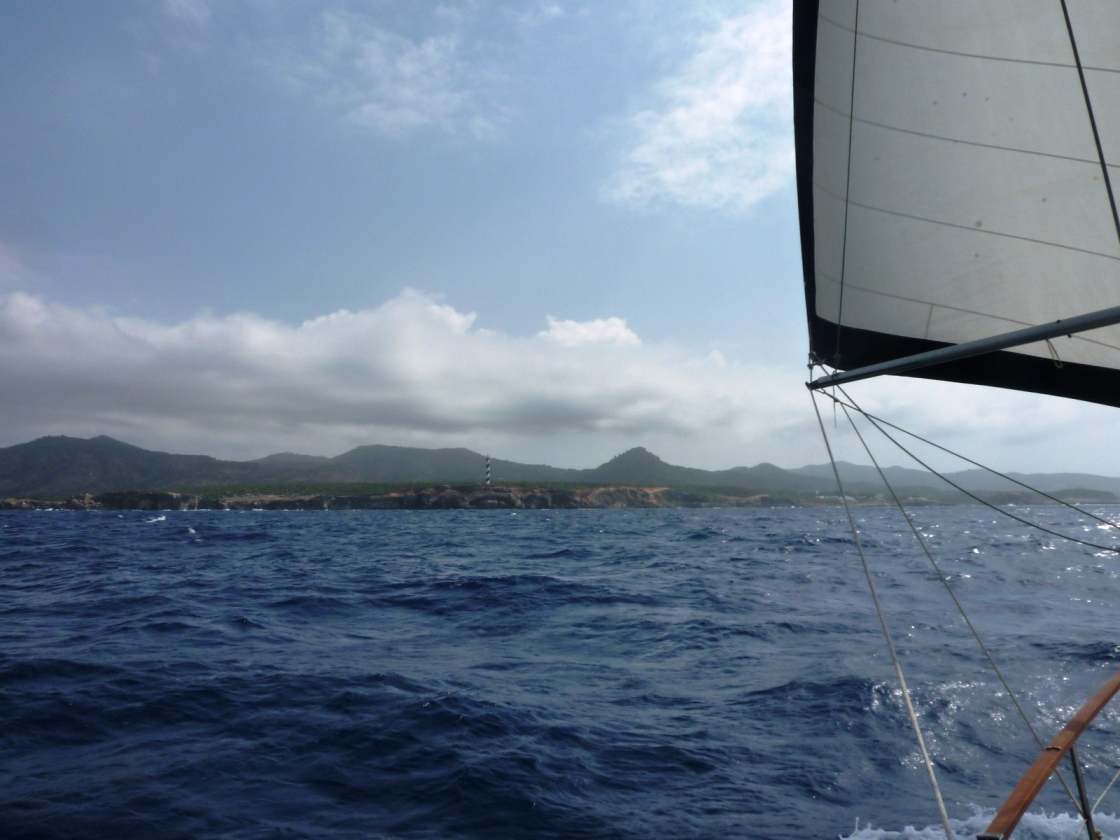
Forecast called for 15 knots wind, the blue. Instead we got the green/yellow stuff!

We had planned to stay in Puerto Pollenca in Mallorca until the end of August and then sail to Menorca, another Balearic Island to the east. We’ve enjoyed the summer in Mallorca, taking many trips inland by bus or rental car, and have enjoyed visiting the many scenic, historical inland cities. The weather was hot in August – in fact the high temperature broke the 50-year record in Mallorca. But on the boat in the anchorage there was always a cooling breeze and rarely uncomfortably hot.
But at the end of August there was a major weather system across the whole Med., a Mistral that roars down from the Gulf of Leon and blankets the seas with gale force wind. It lasted for a whole week, and by the end of that we were feeling bottled up and were anxious to get moving. We had two choices – leave on this day with remnants of the sea and winds, or the next day which will have little wind. We picked the windier day, and on this Tuesday morning we waved goodbye to the many sailing friends we made here and departed for the 35 miles trip to Menorca.

Eliza enjoying the ride....most of the time

The marine weather between Menorca and Mallorca is notoriously unpredictable, as the strong north wind gets deflected by Menorca, and may leave the strait between the two islands relatively calm. But Menorca is a low-lying island with no tall mountains, so the deflection does not always work. As was the case on this day. The forecast called for a very manageable 15 knots, overcast sky. But once we left Mallorca, we were hit by a squall. Dark clouds filled the sky and cold rain poured down in large drops. Wind picked up to 30 knots, and waves quickly built to over 3 meters. We were caught with too much canvas. With a deeply reefed jib and full main, we were surfing down large waves on a board-reach at 8.5 knots – a record for us. But the Nauticat was in complete control, and rock-solid stable. Her directional control is excellent, despite the large quartering waves. Often when we were in marinas or anchorages, we watched those ‘Med boats’ with envy as they turn on a dime with nice maneuverability in tight quarters. But those light-displacement boats with narrow keels will not do too well in these conditions. I will never complain again about my heavy displacement boat with her long keel!

Nothing feels better than arriving at a beautiful, sheltered anchorage after a tough passage!

Saturday, August 18, 2012

Ibiza Town and beaches July 25, 2012


We took the bus from San Antonio to the city of Ibiza/Eivissa. It’s also known as the 'white island' due to the predominance of its white houses.  The Ibiza we know is the disco/club central, the summertime hedonistic capital of Europe.  La calle Barcelona is the central point of the city’s nightlife, based around the Port.  We did not go there. However, there are a number of interesting historical monuments which offer a bit of cultural, historical and natural richness within the city. We visited the 16th century walled city of Dalt Vila, a UNESCO World Heritage site.  The wall was built by Felipe II in the 16th century to protect the island from pirates and the Ottomans.  Portal de Ses Taules, with a drawn bridge, is the main entrance to the Dalt Vila.  And once inside, we visited the Almudaina Castle, which was built during the Moorish period 12 & 13 centuries, and the Virgen de las Nieves Cathedral which was built upon an ancient Mosque in the 13th century in Gothic-Cataln style. Walked along the wall, we enjoyed the impressive view of the Port, the city below, and on a clear day, Formentera could be seen as well.  Although Archeological Museum was closed for renovation and the Episcopal Palace was now the Bishop’s resident and not open for public, we managed to visit the old Town Hall, which housed excellent pictures of the city’s past and present.  The Puig de Molins Monographic Museum, offered some of the best Punic art in Europe.  We were also thinking of venturing into the La Penya neighbourhood, located just below the Dalt Vila, but the staff in the tourist office was sternly against the idea as it was ‘not safe’. Instead, she offered a great number of great restaurants for us to try out.  We gladly took her advice and had an excellent lunch of traditional dishes of paella and fish at a small restaurant just outside the old city.

Entrance to the walled Old City

the Cathedral


  View from the Monographic Museum to the town harbor

Monday, July 23, 2012

July 20, 2012 Island of Ibiza


We waited for favorable east winds to sail the 50 miles from Mallorca to Ibiza. After a few hours of motoring, the wind picked up as predicted, directly astern at 15-20 knots. The waves began to build up quickly, but with wind and waves behind us, we were sailing comfortably under poled out jib and staysail. These days, with the luxury of simply waiting until the wind is right, we hardly need to run the engine anymore. It feels great!

 2 meter waves behind us...but the picture doesn't do it justice

Ibiza sunset, at San Antonio

Ibiza covers 575 Km2 and has a population of over 100,000. There is only one river, the Santa Eularia, on the whole island. The northern part of the island, known as Els Amunts, is made up of fertile land, small forests and almond and olive groves. The coast is spectacular with pretty coves and dramatic cliffs. The excellent sandy beaches are well equipped for tourists. The main touristic beaches are Portinatx, Port de Sant Miquel and Sant Vicenç
After nine hours, we saw land.  The trouble with sailing with winds behind us is that, by definition the approaching shore is a lee shore, and there were large breaking waves all over the shoreline. For better protection, we went into Cala Portinatx, against a backdrop of wooded mountains.  It was an attractive bay with three arms, each with a sandy beach, although crowded with sun bathers, pedalos and such. Since it’s a Saturday, it’s not unusual for the area hotel/restaurant to have some night music started at 9:30pm.  We did not think too much of it when the music went on into the night.  However, it went on till the wee hours of next morning …. 5AM should be considered morning …. it must be wonderful to be young and energetic, to be able to appreciate this ear-piercing ‘thump..thump...thump’ noise called music!

typical clubbers (not counting the one in sunglasses...) 

A nice day at the beach

another beautiful sunset at San Antonio

Where did we go next?  An even better known party town, San Antonio Abad de Portmany.  It used be a fishing village but has developed into mostly a touristic, partying town. The deep bay is well-protected by a breakwater and therefore, a good base for us to stay to do some regular boat maintenance and explore the island.  Not surprisingly, by day it’s a quiet city (the clubbers must be in bed still), but at night there are a lot of people out on the streets looking for nightlife. Just outside the city in the surrounding areas, they have some of the “best” clubs on the island.

The citadel at Ibiza city

San Antonio may not have the culture or the tranquility, but it does have one thing – priceless sunset view.  There are ‘sunset strips’, crowded with premium priced restaurants for those who wish to catch the Kodak moment.  We enjoyed the view every evening on 3Rivers, priceless indeed.

Ibiza actually has some merits for older matured visitors.

Sunday, July 22, 2012

July 13, 2012 Leaving Mallorca, slowly


sailing around the north shore of Mallorca 

Hiking at Soller with Len and Lesley, friends from Pollenca 

Soller harbor 

After spending three weeks relaxing in Puerto Pollenca, meeting up with friends from Barcelona, it’s time to move on.  Forecast was calling for NE wind, which was promising for 3Rivers to head west around the north shore of Mallorca, to get closer to Ibiza. Since Puerto Pollenca is a huge bay, it takes almost 2 hours motoring in strong headwinds, just to get out.  But as soon as we turned the corner, we were ready to sail. And true to any weather forecast, the wind is always 5 to 10 knots either more or less than expected and we got more.  We were told that Cala de la Calobra, behind the Torrente de Pareis, a large and spectacular bay with a slit in the high rocky cliffs, could be an excellent spot to anchor.  However, the bay was too exposed on this day and we saw three fair sized yachts rolling not-so-happily as swells were making their way into the bay.  So we decided to head to Soller, one of our favorite towns and the only harbour of refuge on the whole 50 mile stretch of the rugged, inhospitable northwest coast of Mallorca.  The last time we were here, it was in May and the place looked so different after two months.  Both the marina and the bay were packed with boats.  More tourists on land, and that led to more shops and restaurants open for business.  Another boat from Puerto Pollenca was also there, and we spent time hiking and dining with Len and Lesley until two days later when we each going the opposite way.  We did another five hours run to Sant Elm, but this time, we were sailing with great wind behind us, instead of motoring.  Unfortunately, not so much for Len as he must be bashing into head wind all the way back to Pollenca.

 Sant Elm bay


Things you can do with a dog...

Hiking trail, overlooking the Isla Dragonera 

Road signs for the trails: the large one made of stones points another way.

The second time in Sant Elm was a charm.  It’s a pleasant bay with sandy beaches.  Although small, it’s a growing tourist resort with a nice ice cream shop, and a very nice restaurant called Es Moli.  Ben had made a reservation for a mooring ball (free!) for the first day and were we glad that we did.  The bay looked very chaotic, with boats of all sorts, and water activities going on everywhere.  As soon as we turned into the bay, the port authority staff, the boat traffic controller, zoomed right up to us from his zodiac.  At the time of our arrival, every mooring ball was already taken.  One ‘unauthorized’ boat was told to go to make room for us.  We felt so important. 

The next day, after some boats had left, we’d decided to move closer to shore and anchored just beyond the buoyed off area for swimmers.  The water here was simply crystal clear.

We almost didn’t want to leave Sant Elm as this little place had almost everything we needed.  But strong wind was blowing into the bay, so up the anchor and off to Santa Ponsa we went.  Same as last time we were here, we did not spend too much time checking out the area although it was considered as one of the most picturesque harbours in Mallorca.  Again, boats of all sizes can be seen here, but one in particular, Candido, with a look of a spaceship, was anchoring right in the middle of the cala. 

The next day, it’s time for us to cross the water and to the party land of Ibiza.

Eating our way through the Balearics: our waiter serving John Dory, a delicious local fish 

This has got to be the most extraordinary mega yacht we've seen!

Monday, July 9, 2012

Time to say bye to Pollenca July 6, 2012


The 'Pine Walk' at Pollenca Bay

A day at the beach, looking out to the large anchorage 

Market day at Pollenca


We have been enjoying our stay at Pollenca, and before you know it, three weeks have gone by! After a while Puerto Pollenca has become ‘our’ neighborhood. We know the good restaurants with suckling pig, roasted lamb shoulder, and sizzling steak; the little shop with wonderful home-made pastries; and the well-stocked groceries.  We routinely take the 5-minute dinghy ride from our boat to shore, do a little grocery, or stop by a coffee, or take an evening walk. A few of our friends from Port Vell in Barcelona are also anchored here, plus some new yachties we’ve met, so we have a bit of social life going, including a birthday dinner. Summer has quietly arrived, bringing the occasional heat wave – especially if it’s a south wind from Africa. But most days the temperature is pleasant, as there’s usually a cooling sea breeze at the anchorage. The bay of Pollenca is very big, but it’s well sheltered from the swell from the open sea.

We had one gale which was not really forecasted. It started in the afternoon, and the wind kept strengthening until it peaked with 48 knot gusts. The sound on the rigging was like a freight train, white caps whipped up within the short fetch and immediately blown flat into foamy spindrifts. Boats all around were dragging, including some unoccupied boats that drifted out into the middle of the bay. It was pandemonium! There is a government seaplane hanger at the other side of the bay, and fire-fighting seaplanes routinely takeoff and land on the water. We watched a seaplane landed during the height of the gale, and the plane was blown backwards on the water, unable to reach the hanger! Miraculously our anchor held. It went on for hours until mid night when it finally winded down.  And the hope to watch the Euro 2010 final, Spain vs Italy, was blown off as we wanted to stay on the boat, just in case.  We knew Spain had won, by the sounds of firework and cheering. 

Storm looming, our summer awning wildly flapping 

Forecast called for a moderate 20 knot wind, but it peaked at a gale force level of 50 knots. The blue boat dragged anchor and was getting blown out of the bay.

Seaplane unable to land on the water and forced to depart

Finally it’s time to move on. We picked a blustery day to sail west-ward around the northern coast of Mallorca, towards Ibiza, the next Balearic island. The fresh easterly was directly behind us and we made good speed on a dead run, with poled-out genoa and staysail wing-on-wing. But we had forgotten how choppy the sea can be, with a 15-20 knot wind having blown through the night. Anything not secured in the cabin was sent flying.  Ah, too much wind, too little wind….

 One more hiking trip before leaving Pollenca. This is Saint Boquer, a scenic pass looking out the north coast of Mallorca.

Sunday, June 17, 2012

Puerto Pollenca June 17, 2012


We sailed the 50 miles to Pollenca, stopping at Cala Agulla, a nice bay that’s sheltered from the blustery SE wind for an overnight stay. Overnight the wind reversed directions and started to blow right into the bay. The calm, sheltered anchorage quickly became extremely rolly, so we took off early next morning and sailed, closed-hauled, the rest of the way into Pollenca Bay. We rarely use the engine these days; by taking the time and waiting for favorable weather window, and with anchorages that are all within half-day’s sail, we always sail. It feels great!

Plenty of boats anchored in the Bay of Pollenca 


Polenca is a large, sheltered bay, and some cruisers stay here the entire summer. This will be our last stop before we depart Mallorca and go to Menorca, the eastern Balearic Island. We have been here for a week, just relaxing and visiting surrounding areas. The town at the bay is a large resort town with plenty of restaurants and shops. The old town of Pollenca is actually about 10 km inland, located to provide some safety from attacks by pirates. We took a long walk to the old town on a lovely Thursday morning. It’s a picturesque small town, with a beautiful town square, tidy ochre-coloured stone houses, winding lanes, and of course fine churches, including the 18th-century Parroquia de Nostra Senyora dels Angels and the Convent de Santo Domingo, where it holds Pollenca’s Classical Music Festival in July and August. The musical activities take place in the Cloisters and the grand piano is already there. We also walked 365 steps up a steep hill to visit the chapel El Calvari. It’s a small chapel with a Gothic Christ on the altar carved in wood.  After a lunch rest at Manzana y Peras at Placa Major, we continued for an hour-long hike up a hill to visit the monastery Puig de Maria. The monastery has a commending view over the Bay of Pollenca to the north and the Bay of Alacudia to the south.

Climbing the steps to the chapel El Calvari


The view from Puig de Maria  


The next day, while resting to recover from our long walks, we watched a neighboring boat getting stuck on a shallow patch. The inner Bay of Pollenca, where it is more sheltered, is very shallow with only about 3 meters deep. That’s fine for sailboats that typically have 2 meter draught, except there are some shallow patches less than 2 meter deep. This German boat dropped anchor at the proper depth, but overnight is swung onto the shallow. We spent several hours tried to winch them off, but in the end we needed the help of two powerful dinghies from a nearby sailing school, one pulling a halyard to heel over the boat, and another dinghy to pull the boat off the shallow and against the fresh afternoon breeze. It was quite an exercise. Afterward we had a wonderful supper with our new friends, Achim and Hartwig. The roast suckling pig and lamb shoulder were wonderful!

Lots of help to get Lazy Life unstuck from a shallow patch

A Scenic Drive around the Island June 6


We are tied to a mooring ball at Porto Colom, a large bay completely sheltered like a lagoon. The port authority managed the mooring balls which are intended for visiting yachts, but unfortunately they seem to be mostly used by local boats. We were able to find a vacant ball, but the lead-line is missing so we struggled to lift the heavy ball to tie our line through the chain underneath. The town is a fishing village on one side and a growing economy tourist resort on the other end. It’s a relatively quiet place, not much for scenery, but it’s a perfect place to leave the boat and go inland to do some sightseeing.

We rented a car and crisscrossed the scenic interior of Mallorca. Most of the island is semi-arid, dry with limited vegetation, but some parts are lush and covered with tall pines. We first went to Puig de Randa, on a tall hill overlooking the bay of Palma, there’s a sanctuary, Santuari de Cura. There are few tourists here. The musical sound of monks chanting drifts out of a small souvenir shop. Antique wrought iron farming tools scatter around in the courtyard as ornamental pieces, baking under the hot sun. A large garden anchored by tall palm trees swaying in the mountain breeze, semi-overgrown with exotic flowering plants. This is a wonderful place for meditation.
Santuari de Cura

Quaint towns in the plains of Mallorca


The very pretty, tiny village of Biniagual 

For our lunch stop we visited the small village of Biniagual. Half expecting another touristic place, we were pleasantly surprised to find that it was a beautiful small village nestled among vineyards, with completely no shops. Other than a small busload of German tourists, who quickly left, the village was completely deserted; not a soul was visible. Feeling like we had the whole village to ourselves, we walked through the quiet cobble stone streets lined with old, stylish houses, some with beautiful courtyards and gardens well-hidden by stone walls and tall hedges. A fountain quietly gurgles somewhere in a corner under the shade. Ah, someday, we should have a home like one of those, and properly retire…

  Monasterio de Lluc

Cap de Formentor

We visited the Monasterio de Lluc, an institution regarded by many to be the spiritual heart of Mallorca. Built in the 17th and 18th century, the monastery has an imposing Baroque church which contains the stone image of La Morenta, the Black Virgin of Lluc, supposedly found by a Shepard boy on a nearby hilltop in the 13th century. We kept driving to the northern tip of the island, to Cap de Formentor, where the land narrows to a  strip of barren shear cliffs rising above the clear blue water of the open sea. It’s a beautiful spot, but too popular with tourists and the trails were crowded. So we turned around and headed back to our quiet anchorage, our smart phone/GPS guiding us through a labyrinth of deserted back-roads and through beautiful towns that were quiet in the late-afternoon heat.