Farewell Croatia June 9 2011
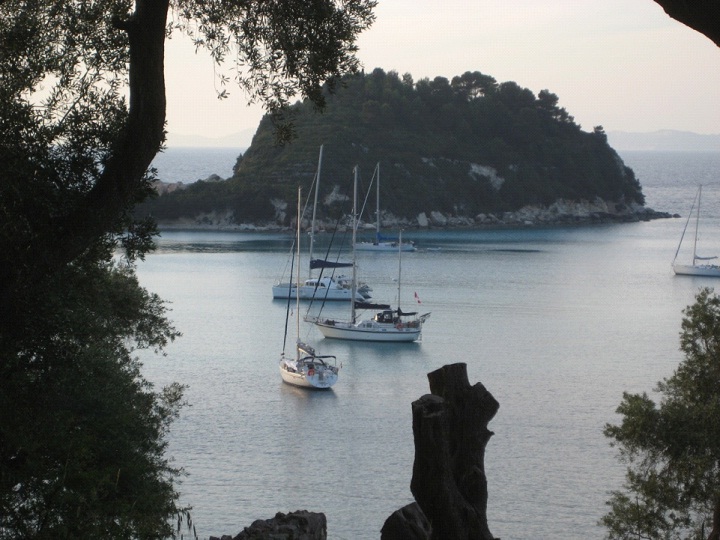
We are only half-way up the Croatian coast but unfortunately our time is up and we need to start heading south to Italy. It’s with mixed feelings to haul up the anchor at Uvala Razetinovac, where we have spent the last 3 days waiting out the gale warning at the open sea. To get to Brindisi, Italy at the ‘shortest’ distance, we’ve decided to go to Komiza, a fishing village on Vic Island where there’s a customs office to complete the exit formalities.
We arrived at Komiza at 4:30pm, and casted the lines to the harbour attendant. He recommended two lazy lines but we would only stay till we’re done with the exit papers. This is only the second time we took a berth in Croatia! It’s going to be a bit of a wait since the harbourmaster’s office only opens between 8:00am to 1:00pm, and 6:00pm to 8:00pm only. So we took the time to do one last provisioning and for Ben to have his daily ice cream.
Komiza is a pleasant, unassuming little town with harbourfront lined with palm trees. On the southern end of the harbour is the Kastel, a 16th century fortress with a clock tower built onto one of its corners at the end of the 19th century. The town is known for a traditional, sail-powered wooden fishing boat, the Gajeta Falkusa, built on Vis for over 300 years. We had a short walk, completed the exit procedure with just enough time left to have a diner of angler fish stew at Bako, a restaurant by the beach. In the fading light of the evening we headed out to the open Adriatic for Italy. A distant thunderstorm displayed a techni-colour lightning show for us …. then, we’re blanketed in total darkness with little illumination from the passing ferries and freighters, which came less than a quarter mile to 3Rives.
Thursday, June 16, 2011

Tuesday, June 7, 2011
Hvar, Split, and Trogir: Croatia June 5, 2011
We’ve been in Croatia for a few weeks now, keeping our appreciation for travel keen by alternating between popular cities and quiet anchorages. In terms of cities, the Rough Guide to Croatia has the following to say about these three cities:
Hvar town: One of Adriatic’s most bewitching cities
Split: Adriatic’s most vibrant cities, exuberant and hectic
Trogir: Most seductive town on the Dalmatian Coast
Given these colorful descriptions, how can one afford not to check them out!? So we visited all three as we worked out way north-west up the Croatian coast.
For Hvar, we anchored at the little island of Sv Klement, as Hvar harbor looked to be too busy. The bay of Uvala Vinogradisce, on the south of the island, is very popular and when we arrived there were already 16 boats anchored there. We managed to squeeze in, but we put our fenders out just in case. The island has a few restaurants, and across the island is an ACI marina (I think ACI means ‘Absolutely Cost Ineffective’) where one can take a water taxi to Hvar. The island is pleasant enough, pine covered, with some short walking trails, and has a sheltered bay of turquoise blue water, which proved irresistible to some Slovenia guys to urinate into and some German men to swim in (at the same time).
The next day we took a water taxi into town. Hvar is a beautiful town, quite touristy but not overwhelming. Meandering alleys lead uphill to a Roman castle which overlooks the town. It was a refreshing walk for us, having been sitting around in the boat for a few days. On the castle wall one can see a beautiful view of this medieval town with ancient stone houses and Venetian architecture.
 Vibrant city squares
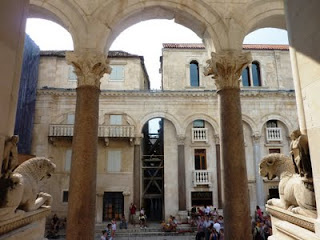
 Diocletian Palace

The next morning, we went to the town market to get some fresh produce, and then took a walk to a large park just outside the city. The pine-covered trail hugs the waterfront and offers a beautiful view of the city and the peninsula. On the way back we were caught by yet another afternoon shower. It seems noon shower is an everyday event here. And then while dinghying back to our boat, the Port Police spotted us and came by to inform us that no anchoring is allowed, and we should go to the marina instead. So instead of paying a 90 Euro marina fee, we decided to leave. That was too bad, as Split is a city that one could spend several days.
Trogir is only a few hours boat ride from Split, on the other side of the peninsula. The whole town is a UNESCO world heritage site. We found a spot on the river outside the town to drop our anchor. At least there’s no no-anchor sign here. It seems most yachts have no problem going to the marina and paying a 90 Euro (or more) per day berth fee. We all complain about Croatia being expensive, but it’s simply supply & demand. From what we have seen, the cruising market in the Med is fundamentally driven by the chartering market. Charter boats flood every marina and every anchorage; entire industry of restaurants and shops are fed by charter boaters. With two to three couples sharing a boat, paying 90 Euros for a day is suddenly affordable.
Our anchor spot on the river, just outside Trogir old town, is a noisy one. Numerous ferries and water taxis roar by at full speed. Right across from us is a large shipyard, with what looks like a huge tanker under construction. But it’s free!
 Trogir, St. Lawrence Cathedral
 Trogir waterfront
The main attraction in Trogir is St. Lawrence’s Cathedral. Built in the 12th century, the cathedral has a fascinating, complex stone carving depicting stories of religion and life. The rest of the town, however, is a bit disappointing. Perhaps it’s that the souvenir shops are a bit crowded, compared to Korcula; or that the restaurant gophers are a bit aggressive; or that the city is sitting on flat land and there is no surprising vistas that open up, unlike Hvar. Or perhaps it’s that we’ve done too much sightseeing with cities. It’s probably time to move on and get back to anchorages at deserted coves. For summer has finally arrived: the days are hot, hazy; mosquitoes are out; winds are light, except when the Bora blows. It reminds us of the EMYR last year, wonderful time we had, but it was roasting hot in the Eastern Med. Hopefully this part of the Adriatic will be somewhat cooler.
Hvar town: One of Adriatic’s most bewitching cities
Split: Adriatic’s most vibrant cities, exuberant and hectic
Trogir: Most seductive town on the Dalmatian Coast
Given these colorful descriptions, how can one afford not to check them out!? So we visited all three as we worked out way north-west up the Croatian coast.
For Hvar, we anchored at the little island of Sv Klement, as Hvar harbor looked to be too busy. The bay of Uvala Vinogradisce, on the south of the island, is very popular and when we arrived there were already 16 boats anchored there. We managed to squeeze in, but we put our fenders out just in case. The island has a few restaurants, and across the island is an ACI marina (I think ACI means ‘Absolutely Cost Ineffective’) where one can take a water taxi to Hvar. The island is pleasant enough, pine covered, with some short walking trails, and has a sheltered bay of turquoise blue water, which proved irresistible to some Slovenia guys to urinate into and some German men to swim in (at the same time).
The next day we took a water taxi into town. Hvar is a beautiful town, quite touristy but not overwhelming. Meandering alleys lead uphill to a Roman castle which overlooks the town. It was a refreshing walk for us, having been sitting around in the boat for a few days. On the castle wall one can see a beautiful view of this medieval town with ancient stone houses and Venetian architecture.
 Hvar
Hvar


The next day, while preparing to leave the island and head towards Split, we experienced a thunder-shower that’s common in this part of Croatia. The sky darkened, followed by fast-approaching lightning and thunder, and then heavy rain that went on for an hour. On the VHF the Split forecast station was breathlessly warning of severe thunderstorm and gale somewhere (which we never figured out exactly where). We hid our laptops into the microwave, and mopped up the few places where water seeped through. We were thinking about Turkey, where we never saw any trace of clouds from June to October.
Eventually we did get to Split. We were expecting to see a harbor crowded with anchored yachts, such as Hvar, but strangely there was only one other sailboat anchoring at the area which the Pilot Guide indicates to be ok to anchor. On the shore, there is a large sign indicating ‘no anchoring’. When in doubt, ignore signs that you don’t like. We dropped our anchor and dinghied into town.
Split is Croatia’s second largest city and we were expecting to see a crowded metropolis, but we were pleasantly surprised: the place is lively, but the streets are very pleasant and it is nice to stroll through the town. The harbor is fronted by a large boardwalk, covered with palm trees. The old town started as a retirement palace for Diocletian, a Roman emperor. Of the original palace, only the mausoleum remains, and it has subsequently been turned into a cathedral. Meandering alleys open up into pretty squares, some big, some small. There are plenty of tourists, but by early evening the place is packed with locals, who are out for a walk, have ice creams, or relaxing in the café’s. It’s a lovely, vibrant city. We found a small restaurant just outside the old city, and had an excellent and reasonably-priced supper of Italian/Croatian dishes.

Split waterfront
 Vibrant city squares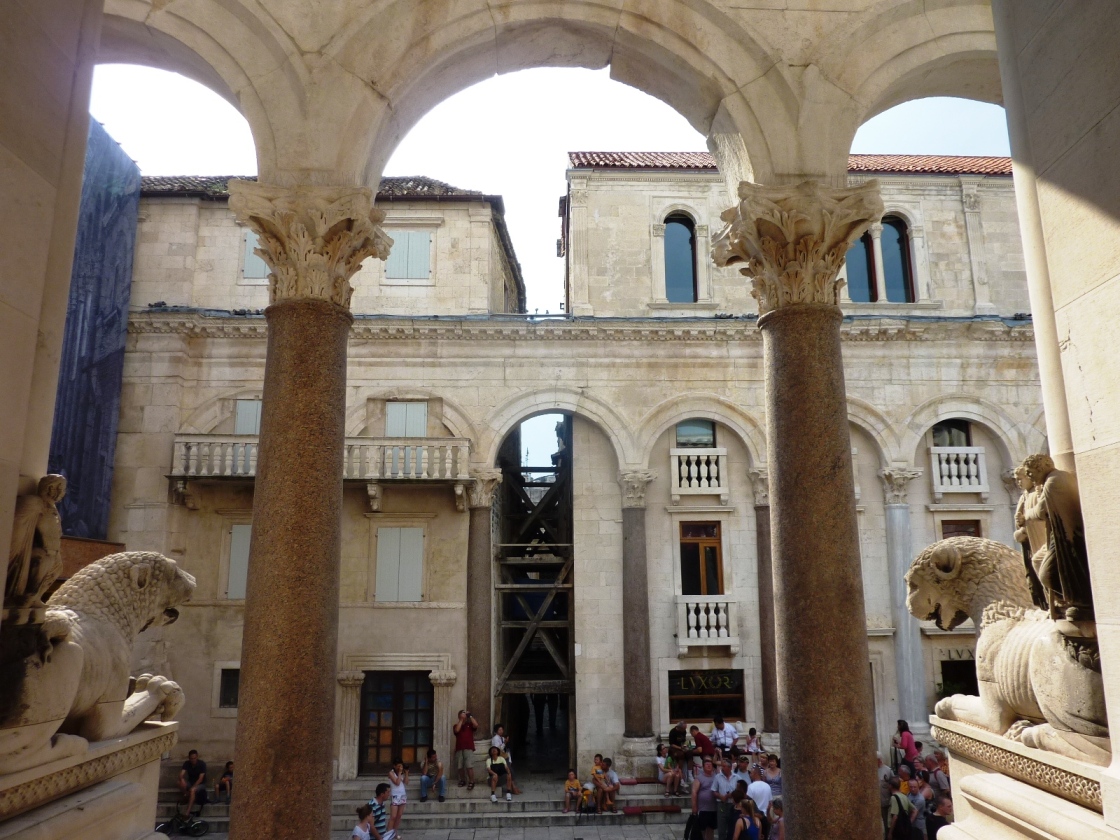
 Diocletian Palace
The next morning, we went to the town market to get some fresh produce, and then took a walk to a large park just outside the city. The pine-covered trail hugs the waterfront and offers a beautiful view of the city and the peninsula. On the way back we were caught by yet another afternoon shower. It seems noon shower is an everyday event here. And then while dinghying back to our boat, the Port Police spotted us and came by to inform us that no anchoring is allowed, and we should go to the marina instead. So instead of paying a 90 Euro marina fee, we decided to leave. That was too bad, as Split is a city that one could spend several days.
Trogir is only a few hours boat ride from Split, on the other side of the peninsula. The whole town is a UNESCO world heritage site. We found a spot on the river outside the town to drop our anchor. At least there’s no no-anchor sign here. It seems most yachts have no problem going to the marina and paying a 90 Euro (or more) per day berth fee. We all complain about Croatia being expensive, but it’s simply supply & demand. From what we have seen, the cruising market in the Med is fundamentally driven by the chartering market. Charter boats flood every marina and every anchorage; entire industry of restaurants and shops are fed by charter boaters. With two to three couples sharing a boat, paying 90 Euros for a day is suddenly affordable.
Our anchor spot on the river, just outside Trogir old town, is a noisy one. Numerous ferries and water taxis roar by at full speed. Right across from us is a large shipyard, with what looks like a huge tanker under construction. But it’s free!
 Trogir, St. Lawrence Cathedral
 Trogir waterfront
The main attraction in Trogir is St. Lawrence’s Cathedral. Built in the 12th century, the cathedral has a fascinating, complex stone carving depicting stories of religion and life. The rest of the town, however, is a bit disappointing. Perhaps it’s that the souvenir shops are a bit crowded, compared to Korcula; or that the restaurant gophers are a bit aggressive; or that the city is sitting on flat land and there is no surprising vistas that open up, unlike Hvar. Or perhaps it’s that we’ve done too much sightseeing with cities. It’s probably time to move on and get back to anchorages at deserted coves. For summer has finally arrived: the days are hot, hazy; mosquitoes are out; winds are light, except when the Bora blows. It reminds us of the EMYR last year, wonderful time we had, but it was roasting hot in the Eastern Med. Hopefully this part of the Adriatic will be somewhat cooler.
Wednesday, June 1, 2011
Anchoring in Uvala Luka-Korcula Island May 30, 2011
Korcula Town is one of Dalmatia’s best preserved medieval town centres, and the birthplace of Marco Polo. Four of the 15th century cylindrical towers, part of the fortifications built to protect the town against the Turkish invasion, are still standing.
Like a mini-version of Dubrovnik, Korcula Town has the usual defensive towers and churches, but with a different type of charm and grace. We walked up a flight of steps to the Land Gate, the main entrance to the old town, on one side of the gate was the Trg brace Radica, a small square bordered an elegant loggia belonging to the 16th century town hall, and St Michael’s Church. Further up was the Church of Our Lady, a simple structure whose floor was paved with the tombstones of Korculan nobles and above the high altar was a mosaic of the Virgin and Child, a dazzling confection of yellows, blues and pinks completed by Dutchman Louis Schrikkel in 1967. Immediately beyond was the St. Mark’s Cathedral, with bizarre exterior and interior stone-carving that looked anything but Christian in inspiration. On the exterior, the main figure directly above the porch was St. Mark, flanked by lions pawing smaller, more subservient animals, while the door was framed by figures of Adam and Eve … in toilet-ready squatting pose. Inside the cathedral, the pillars running along the north side of the nave were decorated with extravagant floral squiggles, in writhing goddess-like forms.
 Sea view of Korcula town
 A view of the city from Forteca
Like a mini-version of Dubrovnik, Korcula Town has the usual defensive towers and churches, but with a different type of charm and grace. We walked up a flight of steps to the Land Gate, the main entrance to the old town, on one side of the gate was the Trg brace Radica, a small square bordered an elegant loggia belonging to the 16th century town hall, and St Michael’s Church. Further up was the Church of Our Lady, a simple structure whose floor was paved with the tombstones of Korculan nobles and above the high altar was a mosaic of the Virgin and Child, a dazzling confection of yellows, blues and pinks completed by Dutchman Louis Schrikkel in 1967. Immediately beyond was the St. Mark’s Cathedral, with bizarre exterior and interior stone-carving that looked anything but Christian in inspiration. On the exterior, the main figure directly above the porch was St. Mark, flanked by lions pawing smaller, more subservient animals, while the door was framed by figures of Adam and Eve … in toilet-ready squatting pose. Inside the cathedral, the pillars running along the north side of the nave were decorated with extravagant floral squiggles, in writhing goddess-like forms.
 Sea view of Korcula town
 Entrance to the old city
 Marco Polo's birthplace?
 A view of the city from Forteca
 A wonderful Croatian diner
After a long walk along the narrow alleys lined with tidy well-ordered grid of grey stone houses, the late afternoon sun with light breeze was most pleasant and welcoming. The narrow streets that branched off the main thoroughfare like the veins of a leaf, by design, were to reduce the effects of wind and sun.
Based from the recommendation by one of the tourist staff, we took the Ulica Bernarda Bernardi (very Italian), a wide walking path leading to the Tower Forteca, a wooded hillside with park-like setting and in front of us, were the splendid post-card perfect views of the old town and the Adriatic beyond.
Also following the recommendation from one of the guide books, we bought sweets and biscuits from Cukarin, winner of the HTZ blue flower award and had dinner at Adio Mare, which was only a few steps away from Marco Polo’s “house”. During peak season, the queue would make the street outside virtually impassable. For main course, Ben had the korculanska pasticada (braised beef in port wine and plum sauce) and Eliza had the modest black risotto (made from pieces of squid with ink included).
Korcula was a beautiful medieval town with friendly locals and Luka was a quiet, scenic, sheltered anchorage with an active sailing club across the bay. All in all, we had a great visit here.
Saturday, May 28, 2011
Mljet National Park, Croatia May 25, 2011
Having had our fill of sightseeing at major cities, we left Dubrovnik and sailed to Mljet Island for some back-to-nature relaxation. Mljet is well known for its lush forests and beautiful lakes, and it has been established as a national park in Croatia since the 1960’s. We were not disappointed. The waterway leading to the anchorage at Polace goes through a meandering stretch of turquoise blue water, surrounded by lush green pine forests on both sides. The anchorage at Polace is a well-sheltered, beautiful bay. Even though this is not yet peak season, the bay was quickly filled up, and by late-afternoon there were close to 20 yachts at anchor. We stayed here for several days, using our dinghy to get to shore for long hikes.
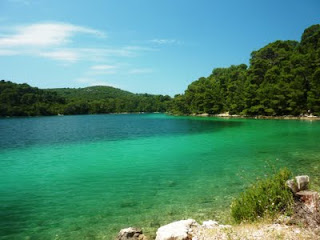 Beautiful color, clear water.
 View of west part of Mljet, after a long hike....
 Monstery at St. Mary's Island
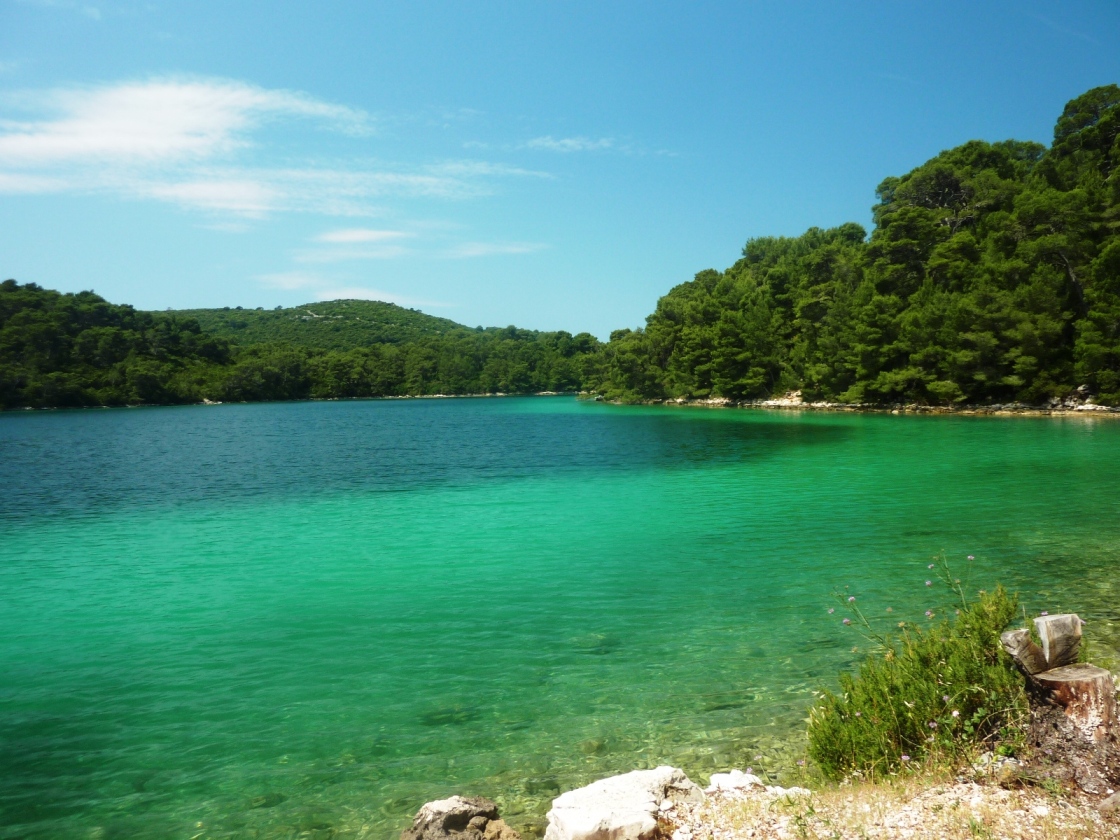 Beautiful color, clear water.
 Anchorage at Polace
 Enjoying a beer and a great view
There are walking paths throughout the park, connecting several small villages that are all within easy walking distances. Some trees are carefully labeled, in Croat and English: Prickley Juniper; Strawberry Tree (no fruits yet, but are budding); Mastich Tree (fine leaves); Rock Rose (defiantly growing from cracks in rocks); Aleppo Pine (spreads tall and wide); Holm Oak (undernourished version of those at home)…
The park entrance fee includes a bus ride and a boat ride to the lakes nearby. The lakes are actually a salt water extension of the sea, fed through a narrow channel from the Adriatic. The color of the water of the lake is astounding. The small ferry brought us to the tiny St. Mary’s island, where there’s a medieval chapel. A pretty walking path circles the island. There’s a nice restaurant by the water, and we sat there and enjoyed the warmth of the late afternoon, watching this lake which has the color of the sea and the temperament of a small mountain lake. There was no boat traffic on the lake, just the lone ferry puttering away. A light breeze crosses the lake; ripples of catspaw; the pine trees murmur in unison.
Wednesday, May 25, 2011
Guest Blog - Matt & Inga
Guest Blog - Matt & Inga Cowan May 21
We are concluding 2 weeks aboard Three Rivers and have enjoyed fabulous hospitality from Ben and Eliza!
We climbed aboard at the harbor of the gorgeous little island of Poros (not to be confused with Paros- which will get you on the wrong ferry entirely), just a one hour hydrofoil ride from Piraeus. Lots of boats from all over the world moored stern or bow to on the pier. Takes some getting used to this squeezing into a tiny spot by backing in and rubbing bumpers with your neighbor.
Lamb and Greek salad for dinner washed down with some pretty “fresh” Greek wine in a tiny taverna, up the steep hill, along a narrow winding alley that has been there for a thousand years or more, makes you feel like you’ve really arrived in Greece.
If you sail with Ben and Eliza you will never go hungry. Ben is in charge of treats and will have sussed out all the places in any harbor that serve ice cream or sell cookies. “Sampling the local cuisine” after all! Eliza’s well stocked galley and precise menu planning deals with main course. Housekeeping on board is down to a fine art- no one can wash dishes as well or with less water than Eliza- don’t interfere with her carefully honed method!

Snacks.
In 2 weeks we have had all manner of different sailing conditions. No wind until noon seemed to be the main pattern in the Ionian Islands (look those up on your atlas!) but one afternoon we were gliding along on a close reach at 6 knots with main, jib and mizzen in the warm sun with rugged little islands floating by - as near to perfect as it gets.

Three Rivers with main and mizzen masts at anchor
One nice blowy afternoon got us up to 8.8 knots- honest speed over ground with Three Rivers just racing along through white caps on aqua coloured water. We won’t mention the times when we ran out of wind and had to motor. We also will not dwell on the breathtaking price of diesel fuel.
One night it was blowing hard in the tiny harbor of Galaxidi where we had tied to the main jetty to go off and find wisdom from the oracle of Delphi (apparently though she was not in residence). At 11 p.m. the harbor master asked us to move around the corner of our pier so that a mega yacht named Chi Qui (pronounce that how you will) 40 meters long! could have our spot. Well, executing a 90 degree turn in a howling onshore wind in the dark took our crew, plus assorted other boaters and locals, all with opinions and unintelligible Greek suggestions. In the howling crosswind we had 6 lines tying the boat to the dock. Our grumpiness was assuaged by the crew (in matching embroidered T-shirts) coming over with a nice bottle of wine to thank us for our trouble. A tour of the boat would also have been nice but our cooperation comes cheap. Next time we are getting “Three Rivers” gear made up!
 Three Rivers with the 40 meter motor yacht ChiQui behind.
 Corfu Yacht Club. Privileges with Conestoga sailing club?
From a sailing point of view, the big event on the trip was the 42 hour passage from Corfu to Dubrovnik (Get out your atlas again here, we certainly had to). Apparently Albania is not boater friendly and you don’t stop there unless the water is rising over the floorboards. We sailed just inside the territorial water limits – to stay out of the shipping lanes. (According to the chart, we transited an old world war 2 mine field.) Next came Montenegro which wants insane sums of money for the privilege of touching their coastline, even if it is only for a day, so off to Croatia it is. It was our longest passage ever and we got it all. Gorgeous south wind on the aft quarter pushing us along at 6-7 knots at the start. Then the wind moves forward, the waves build up and Three Rivers starts to heave up and down. The resulting standing waves were 2 meters high and under full engine power, Three rivers is occasionally pushed to a stop. Inga heaves once too, but the rest of the crew are made of sterner stuff. Inga then took some fantastic anti seasick drugs we bought in Greece (and found them to be a miracle cure) - better living through chemistry! So we had waves, then we had calm, we had wind from all directions and a fabulous enormous rainbow that would lead us to believe there is a pot of gold buried on the north shore of Corfu.
 Sunset at sea
 Not a lot of sail up in this picture! (nor many ripples on the water!)
Entry and exit from countries by boat is very…bureaucratic which is to say frustrating if you are doing it, more amusing if you are watching. I naively thought when it was time to go you just hauled anchor and sailed into the sunset. Not without the proper stamps and papers you don’t!
Leaving Corfu was like something out of a bad cartoon
Scene 1:
We are in a marina 5 miles north of the port of Corfu and we are a non-EU boat (Canuks are special). With 550 boats in dock the marina office amazingly doesn’t know the exit procedure (or perhaps won’t tell us so they can watch the fun) and refers us to the Port Authority office next door which is …closed. We are a resourceful lot and drive our Corfu touring rental car down to the Corfu port where we are told to come back tomorrow when there may be someone there who knows or cares.
Scene 2:
We whistle off to Corfu first thing because the car is due back at 10. After much shuffling from one indifferent but officious sort to the next we are told the port authority back in the marina must first stamp the log and then we must all present ourselves and our passports back there. Back into the little car- Ben driving like the ex-taxi driver he is –to the marina where we cool our heels until the Port Authority doors deigns to open its doors around 9:20. The extra 20 minutes were no doubt for the official to iron her immaculate white outfit. She is young and keen and finds every word of Three Rivers log fascinating and review worthy-- sloooowly. Matt and Ben forgive all because she is gorgeous. “But the Corfu Port should have done all this for you”, she smiles.
Scene 3
Back into the car. Mild mannered ex taxi driver now driving more like Italian cabbie late for lunch. Careen into the Corfu Port Authority waving passports and much sought after stamp only to find that the room we were so recently shooed out of is … closed. By now I’m all for the” sailing into the sunset” scenario, officials be damned. I find it unlikely those gun emplacements have been used recently and we are a small target in any case. Our skipper is, however made of sterner stuff and after corralling an unsuspecting official who carelessly stood where he could be seen, we were hustled past exits and into a small office where a guy in jeans ceremoniously gets a stamp out of a special drawer (like this happens once a decade) stamps around a bit and sends us on our way. As we leave another official shakes his head and tells us the marina port office should have done all this!
By contrast, our arrival in Croatia, in the pretty little port of Cavtat, at 8 a.m was more orderly but much more expensive. We hoist the yellow Q flag to signal we are entering the country and are whistled and waved over to the pier with the big Q painted on it and a silly roped off area like at the bank, which everyone just climbs over. Ben goes off to the port office where he is duly stamped and relieved of 311 Euros for cruising permits and assorted taxes and we are shooed along. Now that our pockets are suitably lightened they don’t want us cluttering up the dock for other potential marks. I can’t believe the pirates of old made out any better although there was no ravishing of damsels (perhaps we were just not their type).
The town of Dubrovnik is amazing. Perched on a peninsula surrounded by huge fortified walls and framed by even higher rugged hills, its red tiled roofs huddle together in an amazingly preserved town from the 1600’s or so. As a UNESCO world heritage site it is a magnet for tourists from everywhere- us included. All evidence of the siege in the latest Balkan war of 1991-2 has been obliterated except for some plaques which show you where the Serbs dropped every mortar and pictures of burned out houses (actually only 6 burned, many more lost their roofs) with the motto “Lest we forget”. A guide gave us a remarkable history lesson on the war and the politics. He quoted Winston Churchill who said “The Balkans produce more history than they can consume.” The same could be said for us- while we learned a lot I still don’t understand why the Serbs hate the Croats so much and where does Bosnia fit into all this? It is amazing to imagine those great stone fortifications coming into use only 19 years ago and gazing up at hills where soldiers launched mortars on civilians below and now it all looks so peaceful. Speculation on when this might happen again is rife.
All in all it was a grand adventure. We are so grateful to Ben and Eliza for having made it possible and for being such great hosts. We’d do it again in a heartbeat. They are right though, it really needs more time and they have made that time. We wish them fair sailing, gracious officials, good company, and may there be an ice cream shop in every port.
We are concluding 2 weeks aboard Three Rivers and have enjoyed fabulous hospitality from Ben and Eliza!
We climbed aboard at the harbor of the gorgeous little island of Poros (not to be confused with Paros- which will get you on the wrong ferry entirely), just a one hour hydrofoil ride from Piraeus. Lots of boats from all over the world moored stern or bow to on the pier. Takes some getting used to this squeezing into a tiny spot by backing in and rubbing bumpers with your neighbor.
Lamb and Greek salad for dinner washed down with some pretty “fresh” Greek wine in a tiny taverna, up the steep hill, along a narrow winding alley that has been there for a thousand years or more, makes you feel like you’ve really arrived in Greece.
If you sail with Ben and Eliza you will never go hungry. Ben is in charge of treats and will have sussed out all the places in any harbor that serve ice cream or sell cookies. “Sampling the local cuisine” after all! Eliza’s well stocked galley and precise menu planning deals with main course. Housekeeping on board is down to a fine art- no one can wash dishes as well or with less water than Eliza- don’t interfere with her carefully honed method!

Snacks.
In 2 weeks we have had all manner of different sailing conditions. No wind until noon seemed to be the main pattern in the Ionian Islands (look those up on your atlas!) but one afternoon we were gliding along on a close reach at 6 knots with main, jib and mizzen in the warm sun with rugged little islands floating by - as near to perfect as it gets.
Three Rivers with main and mizzen masts at anchor
One nice blowy afternoon got us up to 8.8 knots- honest speed over ground with Three Rivers just racing along through white caps on aqua coloured water. We won’t mention the times when we ran out of wind and had to motor. We also will not dwell on the breathtaking price of diesel fuel.
One night it was blowing hard in the tiny harbor of Galaxidi where we had tied to the main jetty to go off and find wisdom from the oracle of Delphi (apparently though she was not in residence). At 11 p.m. the harbor master asked us to move around the corner of our pier so that a mega yacht named Chi Qui (pronounce that how you will) 40 meters long! could have our spot. Well, executing a 90 degree turn in a howling onshore wind in the dark took our crew, plus assorted other boaters and locals, all with opinions and unintelligible Greek suggestions. In the howling crosswind we had 6 lines tying the boat to the dock. Our grumpiness was assuaged by the crew (in matching embroidered T-shirts) coming over with a nice bottle of wine to thank us for our trouble. A tour of the boat would also have been nice but our cooperation comes cheap. Next time we are getting “Three Rivers” gear made up!
 Three Rivers with the 40 meter motor yacht ChiQui behind.
  Corfu Yacht Club. Privileges with Conestoga sailing club?
From a sailing point of view, the big event on the trip was the 42 hour passage from Corfu to Dubrovnik (Get out your atlas again here, we certainly had to). Apparently Albania is not boater friendly and you don’t stop there unless the water is rising over the floorboards. We sailed just inside the territorial water limits – to stay out of the shipping lanes. (According to the chart, we transited an old world war 2 mine field.) Next came Montenegro which wants insane sums of money for the privilege of touching their coastline, even if it is only for a day, so off to Croatia it is. It was our longest passage ever and we got it all. Gorgeous south wind on the aft quarter pushing us along at 6-7 knots at the start. Then the wind moves forward, the waves build up and Three Rivers starts to heave up and down. The resulting standing waves were 2 meters high and under full engine power, Three rivers is occasionally pushed to a stop. Inga heaves once too, but the rest of the crew are made of sterner stuff. Inga then took some fantastic anti seasick drugs we bought in Greece (and found them to be a miracle cure) - better living through chemistry! So we had waves, then we had calm, we had wind from all directions and a fabulous enormous rainbow that would lead us to believe there is a pot of gold buried on the north shore of Corfu.
 Sunset at sea
 Not a lot of sail up in this picture! (nor many ripples on the water!)
Entry and exit from countries by boat is very…bureaucratic which is to say frustrating if you are doing it, more amusing if you are watching. I naively thought when it was time to go you just hauled anchor and sailed into the sunset. Not without the proper stamps and papers you don’t!
Leaving Corfu was like something out of a bad cartoon
Scene 1:
We are in a marina 5 miles north of the port of Corfu and we are a non-EU boat (Canuks are special). With 550 boats in dock the marina office amazingly doesn’t know the exit procedure (or perhaps won’t tell us so they can watch the fun) and refers us to the Port Authority office next door which is …closed. We are a resourceful lot and drive our Corfu touring rental car down to the Corfu port where we are told to come back tomorrow when there may be someone there who knows or cares.
Scene 2:
We whistle off to Corfu first thing because the car is due back at 10. After much shuffling from one indifferent but officious sort to the next we are told the port authority back in the marina must first stamp the log and then we must all present ourselves and our passports back there. Back into the little car- Ben driving like the ex-taxi driver he is –to the marina where we cool our heels until the Port Authority doors deigns to open its doors around 9:20. The extra 20 minutes were no doubt for the official to iron her immaculate white outfit. She is young and keen and finds every word of Three Rivers log fascinating and review worthy-- sloooowly. Matt and Ben forgive all because she is gorgeous. “But the Corfu Port should have done all this for you”, she smiles.
Scene 3
Back into the car. Mild mannered ex taxi driver now driving more like Italian cabbie late for lunch. Careen into the Corfu Port Authority waving passports and much sought after stamp only to find that the room we were so recently shooed out of is … closed. By now I’m all for the” sailing into the sunset” scenario, officials be damned. I find it unlikely those gun emplacements have been used recently and we are a small target in any case. Our skipper is, however made of sterner stuff and after corralling an unsuspecting official who carelessly stood where he could be seen, we were hustled past exits and into a small office where a guy in jeans ceremoniously gets a stamp out of a special drawer (like this happens once a decade) stamps around a bit and sends us on our way. As we leave another official shakes his head and tells us the marina port office should have done all this!
By contrast, our arrival in Croatia, in the pretty little port of Cavtat, at 8 a.m was more orderly but much more expensive. We hoist the yellow Q flag to signal we are entering the country and are whistled and waved over to the pier with the big Q painted on it and a silly roped off area like at the bank, which everyone just climbs over. Ben goes off to the port office where he is duly stamped and relieved of 311 Euros for cruising permits and assorted taxes and we are shooed along. Now that our pockets are suitably lightened they don’t want us cluttering up the dock for other potential marks. I can’t believe the pirates of old made out any better although there was no ravishing of damsels (perhaps we were just not their type).
The town of Dubrovnik is amazing. Perched on a peninsula surrounded by huge fortified walls and framed by even higher rugged hills, its red tiled roofs huddle together in an amazingly preserved town from the 1600’s or so. As a UNESCO world heritage site it is a magnet for tourists from everywhere- us included. All evidence of the siege in the latest Balkan war of 1991-2 has been obliterated except for some plaques which show you where the Serbs dropped every mortar and pictures of burned out houses (actually only 6 burned, many more lost their roofs) with the motto “Lest we forget”. A guide gave us a remarkable history lesson on the war and the politics. He quoted Winston Churchill who said “The Balkans produce more history than they can consume.” The same could be said for us- while we learned a lot I still don’t understand why the Serbs hate the Croats so much and where does Bosnia fit into all this? It is amazing to imagine those great stone fortifications coming into use only 19 years ago and gazing up at hills where soldiers launched mortars on civilians below and now it all looks so peaceful. Speculation on when this might happen again is rife.
All in all it was a grand adventure. We are so grateful to Ben and Eliza for having made it possible and for being such great hosts. We’d do it again in a heartbeat. They are right though, it really needs more time and they have made that time. We wish them fair sailing, gracious officials, good company, and may there be an ice cream shop in every port.
What a day May 20, 2011

What a day May 20, 2011
Our two guests, Matt and Inga left 3 Rivers to return to Ontario. We missed their company. They both are knowledgeable sailors and fun to be with. They not only obliged to 3 Rivers’ do’s and don’ts, but also were not frazzled by 3 Rivers’ heavily indulged meat and sweets diet. With Matt’s help in trimming the sails, splicing the lines, and cleaning the wrenches, 3 Rivers certainly is in better shape than 2 weeks ago. In the mean time, Inga had been busy feeding the crews and she's one great story teller. With her great sense of humour, we're entertained and charmed by her stories everyday. And as soon as we’re on land, we’re ready for “happy hours”, with ouzo “Mini” and party red wine on hands reminiscing over the great sailing we just had. Well, all good things must end somehow as we waved goodbye to the Cowans on the early wee hour when they boarded the bus to Split.
Ben had the master plan of inviting James, a Canadian sailor from Montreal on board to chat about places to visit; change engine oil; and depart the marina by noon when Eliza is done with laundry and provisioning. James did show up, but the oil change didn’t go according to plan. A slight human error had caused oil discharged into the entire engine room, and all sort of pads (mainly baby diapers) were used to absorb the spillage. This hard learn lesson will forever be remembered and hopefully, never to repeat again. On the bright side, Ben was extremely clean, from head to toe; laundry was returned, also extremely clean, from sheet to sheet. We didn’t leave ACI and happy hours continued with our neighboring boat Sideways - Roger, the skipper and his crew, Nick.
What a day!
Tuesday, May 24, 2011
Dubrovnik May 19, 2011
Dubrovnik May 19, 2011
On a refreshing morning we entered the port of Cavtat, the first official port of entry at eastern Croatia. We raised the Croatian courtesy flag and the yellow quarantine flag, and were waved to set aside at the Q town dock for yachts checking in. The check in process was efficiently done. The fees, even though we knew it would be high, were still a shock – about 360 Euros for a cruising permit and taxes. Afterwards, we intended to stay at Cavtat and check out the town, as it seems to be a nice historical city. But we were told that it would cost 35 Euros just for docking for a few hours. We left in a hurry.
Yes, Croatia is expensive, as we had been told. It seems the high price is not hurting the market demand; the area is packed with tourists even though this is not high season yet. We checked into the ACI Dubrovnik Marina, which charges 90 Euro/day for docking for the size of 3 Rivers. It is expensive, but we liked the convenience of a short bus hop into town for sightseeing.
On a refreshing morning we entered the port of Cavtat, the first official port of entry at eastern Croatia. We raised the Croatian courtesy flag and the yellow quarantine flag, and were waved to set aside at the Q town dock for yachts checking in. The check in process was efficiently done. The fees, even though we knew it would be high, were still a shock – about 360 Euros for a cruising permit and taxes. Afterwards, we intended to stay at Cavtat and check out the town, as it seems to be a nice historical city. But we were told that it would cost 35 Euros just for docking for a few hours. We left in a hurry.
Yes, Croatia is expensive, as we had been told. It seems the high price is not hurting the market demand; the area is packed with tourists even though this is not high season yet. We checked into the ACI Dubrovnik Marina, which charges 90 Euro/day for docking for the size of 3 Rivers. It is expensive, but we liked the convenience of a short bus hop into town for sightseeing.
 Dubrovnik harbor and old town, viewed from sea
 A guided tour on the war of 1991
 Up on the city wall

From a distance, the old town of Dubrovnik is striking. Protected by an impressive fortress wall, and gradually rises up on a hill, the town is dotted by houses with uniform red tile roofs. The same uniformity continues in the city outside the castle walls; although on closer inspection some newer houses, especially those built in the communist era, are of lesser quality. The redeeming feature of the city, we find, is the trees: everywhere there are graceful, old growth trees, pines and cypress, their large, weathered trunks holding tall and straight, soaring above human dwellings and reaching into the sky. Somehow these trees manage to survive the eons of human development, and wars.
War as recent as two decades ago, resulting from the breakdown of Yugoslavia caused massive toll in lives and property damage, and even today the scars of war seem still much in the physic of Croatians. To get an understanding of the Croatian’s perspective of the war, we joined a tour in the old city that focused on the siege of Dubrovnik. The tour guide, who was sixteen when the war started, spoke of the age-old cycles of peaceful coexistence and conflict between ethnicities and religions. The old town was shelled during the siege, and pock marks are still everywhere, on century-old walls and stone pavements. At the centre of the town square stands Orlando’s Column, a carved armored knight who according to legend is the savior of Dubrovnik. If history repeats itself, as it often does, Orlando’s vigilance will be much needed indeed.
To appreciate what this medieval city has to offer, we walked the city walls, which’s 25 meters high and completely surrounding the old town. The walls are encrusted with towers and bastions, some parts date back to the tenth century, but most of the original construction was undertaken in the 12th and 13th centuries, with rebuildings and reinforcements carried out in the mid-fifteenth century when fear of Ottoman expansion was at its height. From the top, a sea of terracotta tiles is the predominant view, with domes and towers of the Franciscan Monastery, the St. Saviour’s Church, the Rupe Museum, the Jesuit Church, the stately Cathedral, the Rector’s Palace, the St. Blaise’s Church, the Dominican Monastery and the bell tower within. At the old port, yachts are not allowed to dock there. It’s busy with fishing boats. taxi-boats and tripping boats taking riders to Lokrum and Cavtat. And to relax, there’s no better place than to enjoy a cup of coffee or a glass of icy beer at the pavement cafés at the Luza Square.
Dubrovnik is rich with cultural activities and we attended a violin/piano and classical guitar concert at the St. Saviour Church. Afterward, the four of us slowly strolled along the limestone streets, enjoyed our last evening at this vibrant, magnificent city.
Subscribe to:
Posts (Atom)